Health Care Systems Oncology, Imaging and Pharmacology, particularly for Prostate Cancer.
Technology that interests me: Sensors (Radar, Sonar, EO/IR,Fusion) Communications, Satellites, Unmanned Vehicles (UAV), Information Technology, Intelligent Transportation
Broadband satellite terminals using Iridium Pilot and OpenPort have been
found to contain undocumented hardcoded login credentials (CWE-798).
Additionally, these broadband satellite terminals utilize an insecure
proprietary communications protocol that allows unauthenticated users to
perform privileged operations on the devices (CWE-306)
A remote unauthenticated attacker may be able to gain privileged access
to the device. Additionally, a remote unauthenticated attacker may be
able to execute arbitrary code on the device.
GREENSBORO, N.C. -- The Atlantic Coast Conference and the University of Maryland have settled their legal dispute over the Terrapins' exit from the league. Under terms announced Friday, the ACC will keep the roughly $31.4 million it had previously withheld from Maryland and the school will not owe the conference any more money.
The University of Maryland and the Atlantic Coast Conference ended their legal dispute Friday with an agreement under which the school will pay $31.3 million of the original $52 million exit fee the conference was demanding.
provision of real time alerts from Iron Dome tracking radar to targeted civilians via cell network and smartphone app may be more effective in limiting casualties than interceptor missiles. If British had it in WW2, they could have dodged the V2. Similar technology could be used in US for rapid moving Tornado and Wild Fire alerting.
why have Israeli casualties from rocket attacks been so low in the current round of volleys, with only one civilian casualty on the Israeli side? Postol credits Israel’s early warning system, which gives Israelis 10 seconds or so of time to seek shelter before a rocket blast. The actual warning time can be longer.
Red Alert receives notifications when rockets are being launched from Gaza, and automatically sends out a push notification to users via the downloaded app. Their phone will play an emergency tone and display the name of the targeted community. The free app is available on iOS and Android devices.
Last year, Benjamin Honig, a senior at the School of Information Studies (iSchool), won a scholarship award from Apple that provided him with admission to the company’s yearly Worldwide Developers Conference (WWDC) in San Francisco. While attending the WWDC in June, Honig met Arik Sosman, a student studying in Germany who was also an Apple Scholarship winner. The two became friends and stayed in touch through Facebook.
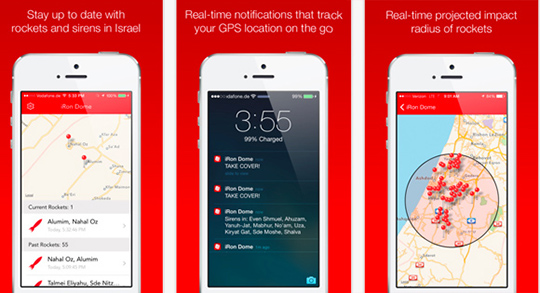
Although a mobile app called Red Alert, was already available to warn Israelis of rocket attacks, it did not allow users to customize their current location, or use GPS location data for alerts. iRon Dome actively tracks a user’s location in Israel and provides nuanced alerts based on real-time location and rocket information.
“Our application is about 30 seconds faster than Red Alert,” notes Honig, “and it tracks your GPS location at all times when the app is open—if a rocket has been predicted to land within your area, a ‘take cover’ alert is generated.”
The iRon Dome application also provides a map of rocket attacks, something the Red Alert app does not currently offer.
Information Warfare: Iron Dome And The Truth September 3,
2014: The ferocity with which some Western (and nearly all Arab)
military analysts attack Israeli efforts to defend themselves is
remarkable, and often spectacularly wrong. Even Israeli systems that are
purely defensive are subject to ferocious, and usually false,
criticism. One of the worst recent examples were the critics who claimed
that it was technically impossible for the Israeli Iron Dome
anti-rocket system to shoot down Palestinian rockets aimed at populated
areas.
Watchmaker
the Timex Group on Wednesday announced its entry into the smartwatch
market with a fitness-oriented model that has its own mobile network
connection.
Smartwatches have relied on links to smartphones for connectivity,
but the untethered Ironman One GPS+ allows users to leave their phones
at home while enjoying online access on the go.
The model is being marketed at running enthusiasts, but it's also a
music and messaging tool. It comes with a year of mobile data
connectivity with AT&T in the U.S., according to the Timex website.
- See more at:
http://www.itnews.com/personal-electronics/81904/timex-ironman-smartwatch-skips-smartphone-connection?source=ITNEWSNLE_nlt_itndaily_2014-08-06#sthash.aq3jFNOc.dpuf
Watchmaker
the Timex Group on Wednesday announced its entry into the smartwatch
market with a fitness-oriented model that has its own mobile network
connection.
Smartwatches have relied on links to smartphones for connectivity,
but the untethered Ironman One GPS+ allows users to leave their phones
at home while enjoying online access on the go.
The model is being marketed at running enthusiasts, but it's also a
music and messaging tool. It comes with a year of mobile data
connectivity with AT&T in the U.S., according to the Timex website.
- See more at:
http://www.itnews.com/personal-electronics/81904/timex-ironman-smartwatch-skips-smartphone-connection?source=ITNEWSNLE_nlt_itndaily_2014-08-06#sthash.aq3jFNOc.dpuf
Timex's new Ironman smartwatch does data without a smartphone
Timex just added a new entry to its Ironman line
of GPS watches, 'cept it's not just any ole timepiece this time -- it's
a 3G-connected smartwatch that doesn't even need to pair up with a
phone. The company calls it the Ironman One GPS+, and while it may have
features commonly found in a smartwatch, it was made mostly for athletes
like its predecessors. It has the capability to upload your run data to
a fitness website with one tap, for instance, and you can even assign
contacts to monitor your run in real time. One version also comes with a
heart monitor a la Samsung Gear Fit
and a chest strap, but unlike the ordinary one that costs $399 (which
is already steep, as other smartwatches today cost around $200), it'll
set you back $450.
Timex And Qualcomm Team Up To Make A Smartwatch For Fitness Freaks | TechCrunch
There are a few things everyone knows about smartwatches right now.
First, you must have an e-ink screen. Second you have to use them with a
phone nearby. Third, they’re not very rugged. Timex and Qualcomm, however, have decided to blow those myths out of the water.
Their new product, the Timex Ironman One GPS+, is a self-contained
sports watch that allows for GPS location tracking, email-based wireless
messaging, and systems to track your speed, distance, and position at
all times as well as notify your friends and family of where you are. It
connects to cellular networks via AT&T, has a large color
touchscreen and includes one year of mobile data service.
The Ebola virus, pictured here, causes disease that currently leads
to death in 25 to 90 percent of cases. (Transmission electron micrograph
image of Ebola virus, courtesy of the Centers for Disease Control and
Prevention.)
One has to wonder how much of this deadly virus has been shipped and stored around the world for the NIH Ebola Study.
Newsweek - The Secret Serum That Could Cure Ebola
As the Ebola virus continues to spread through West Africa—where the
death toll has now reached almost 900—an experimental drug previously
untested in humans may offer a cure. The treatment, known as ZMapp, was
developed by Mapp Biopharmaceutical in San Diego. The company has
recently hinted that it may be ramping up production of the "secret
serum."
A pharmaceutical company in San Diego is behind a groundbreaking medicine given to the two Ebola victims from America. The
secret drug cocktail, called Z-Mapp, has not been tried on humans
before, but has shown effective signs of improving symptoms in monkeys.
The medicine was developed at Mapp Biopharmaceutical in Sorrento Valley
and development of it has been in the works for 10 years.
The other institutions and scientists on the NIH National Institute of
Allergy and Infectious Diseases (NIAID) Centers for Excellence in
Translational Research (CETR) program grant, number U19AI109762, include
According to first author James Pettitt of the U.S. Army
Medical Research Institute of Infectious Diseases (USAMRIID), the research team
previously demonstrated that the treatment — known as MB - 003 — protected 100
percent of non - human primates when given one hour after Ebola exposure. Two -
thirds of the animals were protected when treated 48 hours after exposure. In
the current study , 43 percent of infected non - human primates recovered after
receiving the treatment intravenously 104 to 120 hours after infection. Th e experimental
design differed significantly from the team’s earlier work — this time, infected
animals were not treated until they developed measurable symptoms of disease.
A new Ebola virus study resulting from a widespread scientific
collaboration has shown promising preliminary results, preventing
disease in infected nonhuman primates using monoclonal antibodies.
In this week's online edition of the
Proceedings of the National Academy of Sciences (PNAS), the research
team describes a proof-of-concept for using a "cocktail" of monoclonal
antibodies, or mAbs, to prevent lethal disease in rhesus macaques. When
administered one hour after infection, all animals survived. Two-thirds
of the animals were protected even when the treatment, known as MB-003,
was administered 48 hours after infection.
There is no cure for Ebola. But don't tell that to traders. Shares
of a Vancouver-based company working on a drug to treat the infectious
disease surged nearly 40% last week.Tekmira Pharmaceuticals (TKMR)
popped on much higher trading volume than usual because investors are
hopeful that health agencies in the United States might approve its
drug, known as TKM-Ebola
August 2, 2014: There have
been rumors for years that cartels have used drone (UAV) aircraft to fly
drugs over the U.S. border. Now the rumors come with statistics. Though
no U.S. security agency is on the record about cartel drone operations,
one estimate making the rounds is that cartels flew approximately 150
drone smuggling missions in 2012. The drones transport high value drugs
such as cocaine. Using drones to smuggle drugs is inevitable. Drones
have a small radar signature. They are cheaper to acquire and use than
other options, such as building a long tunnel. The UAVs can carry small
payloads (2-3 kg/4.4-6.6 pounds) but have the endurance and range to fly
over a hundred kilometers and land automatically (usually by parachute)
at a specific location. All this is controlled by an onboard flight
computer and GPS. Someone on the U.S. side can refuel and launch the UAV
on a return trip. Such UAVs can be bought for under $20,000 and used
dozens of times. (Austin Bay)
Mexico’s most dominant cartel, the
Sinaloa Federation has always been quick to grasp the potential of new
technology and it has now begun to replace traditional drug “mules” – as
those who make the border crossings are known – with a low-risk
automated alternative: drones.
Drug traffickers are known to have used
foreign-built drones since at least 2010, when Mexico’s Public Security
Secretariat (SSP) first acknowledged criminal use of ultra-lightweight
UAVs to smuggle cocaine into the United States. SSP Undersecretary Francisco Gonzalez
said that the planes weighed about 100 pounds and each could transport
100 kilograms of cocaine per trip. Purchased in Colombia for $1,700,
each kilo of cocaine would be worth $8,000 in Mexico and could sell for
$30,000 in the United States, Gonzalez explained, meaning that
traffickers could earn $2 million for every successful voyage.
Latin America Herald Tribune reports
that the ministry said it paid $23.5 million for each Hermes 450, an
unmanned aerial vehicle manufactured by Israel’s Elbit Systems, but it
declined to say how many units were purchased.
The Hermes 450, which is being used in the southwestern portion of
the United States to watch the border with Mexico, has an electronic
system that can provide information in real time and allows the aircraft
to fly independently with the help of a GPS system.
Drug cartels in Mexico are making their own drones or unmanned aircraft
to smuggle drugs into the United States, for which workers are using
companies that have assembly plants in Mexico drones, according to
information from the U.S. Drug Enforcement Agency ( DEA). Narcodrones
have been used for drug trafficking on the border with the United States
since 2011, some of which have been secured by members of different
agencies after being knocked down to cross into U.S. territory ...
The announcement came the
day The New York Times published a story revealing that U.S. agencies
have been sending an undetermined number of Global Hawk drones to
interior Mexico since last month.
Homeland Security drones flew along the U.S.-Mexico border in past years to gather intelligence on organized crime.
Global
Hawks are military drones that have been used for surveillance missions
in Afghan istan as well as for relief efforts in natural disaster
zones. Global Hawks can look over areas as large as 40,000 square miles.
Drug cartels in Mexico today make their own
drones to evade security strategies and smuggle drugs into the United
States, according to information from the Drug Enforcement
Administration (DEA).
According to data from the DEA distributed
here by local media, unmanned aircraft have been used to smuggle drugs
into the U.S. border since 2011, but they were purchased abroad, mainly
in Israel.
However, that situation has changed since early 2014 with the launch
of an own manufacturing process, requiring fewer resources than those
used to build tunnels or semisubmerge ships.
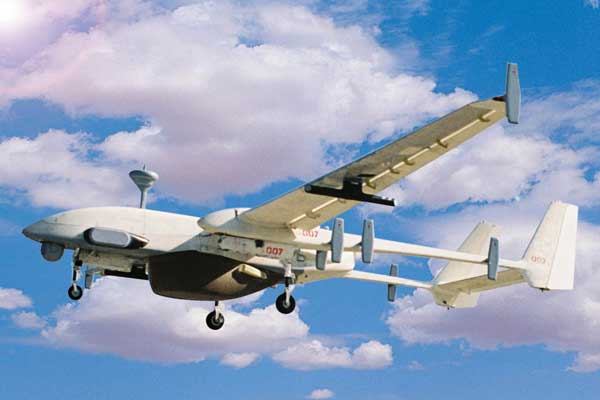
August 2, 2014: While the American [GA-ASI] Predator UAV gets most of the publicity, the similar Israeli [IAI] Heron also first flew twenty years ago and nearly equals Predator production (360). Moreover Heron has been exported to more foreign countries for a wider range of uses (especially maritime patrol). Heron is the primary heavy UAV for the Israeli military, which makes sense as it was Israel, not the United States that pioneered UAVs of this type.
August 1994
The first Predator® unmanned aerial vehicle is flown at GA's flight test facility.
Abraham Karem’s 200-pound, long-endurance
UAV named Albatross so impressed DARPA that it put together funding with the Navy
and ordered a more advanced version that led directly to the Predator. (Chad Slattery)
It was the Israeli successes in UAV technology that motivated Neal and Linden Blue, owners of an American firm (General Atomics) to acquire the assets of Leading Systems out of bankruptcy in 1990 and with it the Abe Karem (former IAI UAV designer) developed Gnat-750 and create the MQ-1 Predator.
Israel continues to produce a lot of Herons while Predator production has sharply declined as orders from the CIA and U.S. Air Force disappear. Part of the reason for continued production of Heron is the development of new variants.
Speaking at an Air Force Association forum in Washington, D.C., this
week, outgoing Air Combat Command chief Gen. Mike Hostage blasted
America's obsession with drones as unrealistic and potentially
dangerous.
"There's a love affair out there in the aviation world with the
concept of unmanned [aerial vehicles], but I really need a human tightly
in the loop," Hostage argued.
As the general explained it, drones may be all well and good in an
environment like Afghanistan, where opposing forces lack an air force or
even air defenses more sophisticated than AK-47s and RPGs. But in any
"contested environment" in which America is asked to do battle against a
modern foe, Hostage argued forcefully for the need to field fighter
jets, electronic warfare aircraft, and top-notch surveillance aircraft
-- all with pilots in the cockpits.
Drones, which can be jammed by opposing electronic warfare
specialists or shot down by more powerful fighter aircraft, won't do the
trick, Hostage said. And to make sure there was no misunderstanding, he
spelled it out: "The kind of platform that [the U.S. needs] is not an
MQ-X, it's not a Predator, not a Reaper."
Executive Summary: The bill’s main feature is to authorize a “Veterans choice card” for certain veterans so they can get health services outside the VA system if they cannot get an appointment in that system within the department’s wait time goals. It also provides the card to veterans residing more than 40 miles from a VA facility. The government is then to reimburse the non-VA health care provider for the services provided to the veteran. The bill authorizes and appropriates $10 billion for this purpose. This program is authorized for three years or until these funds are exhausted, whichever is earlier.
It creates a Commission on Care to examine the access of veterans to VA health care and how best to deliver health care to veterans over the next 20 years.
It authorizes the secretary to hold accountable senior executives if the secretary determines performance warrants it.
CBO estimates the bill will increase the deficit by $12.8 billion over the next five years and by $10 billion in the 10-year budget window.
Raytheon successfully completed a test readiness review (TRR) of the DDG-1000 Zumwalt total-ship computing environment software, release seven, which involved
550,000 lines of code.
A Test Readiness Review (TRR) is conducted to determine if the
system under review is ready to proceed into formal testing by
deciding whether the test procedures are complete and verify their
compliance with test plans and descriptions. A TRR is normally
conducted before each major test configuration item including
hardware and software and provides management with the assurance
that a system has undergone a thorough test process and is ready
for turnover to the next test phase.
The program also involved
a test of the warship's AN/SPY-3 multi-function radar, which
successfully tracked air targets using its diverse search and track
modes, together with the new volume search.
are being awarded a combined $116,750,000 modification to a previously awarded multiple award contract to exercise options for systems engineering and integration for
the Multifunctional Information Distribution System (MIDS) Low Volume Terminal (LVT) and
the MIDS Joint Tactical Radio Systems (JTRS) terminal.
MIDS LVT Terminal
The MIDS-LVT provides secure, high-capacity,jam-resistant, digital data and voice communications capability for Navy, Air Force and Army platforms.
MIDS JTRS Terminal
MIDS JTRS is a pre-planned product improvement replacement transforming the MIDS-LVT into a four-channel, software communications architecture compliant JTRS terminal while maintaining current Link 16 and tactical air navigation capability.
For Data Link Solutions, LLC, work will be performed in Wayne, New Jersey (50 percent) and Cedar Rapids, Iowa (50 percent). For ViaSat, Inc., work will be performed in Carlsbad, California. Work is expected to be completed by March 9, 2015. No funds are obligated at the time of award. Funds will be obligated as delivery orders are issued in the future. No contract funds will expire at the end of the current fiscal year.
The 45th Space Wing supported a successful United Launch Alliance Delta
IV vehicle carrying Air Force Space Command mission assets for the Air
Force July 28.
The AFSPC-4 mission payload included two satellites for the
Geosynchronous Space Situational Awareness Program, or GSSAP, and an Air
Force Research Laboratory experimental satellite.
two GSSAP spacecraft and the AFRL ANGELS experimental spacecraft launched on the same United Launch Alliance Delta IV booster out of
Cape Canaveral, Florida. The missions and objectives are distinctly
different.
The two operational satellites are part of the Air Force's Geosynchronous Space Situational Awareness Program, or GSSAP. The GSSAP satellites will provide U.S. Strategic Command with space
situational awareness data allowing for more accurate tracking and
characterization of man-made orbiting objects.
The experimental satellite program, known as Automated Navigation and
Guidance Experiment for Local Space, or ANGELS, is led by the Air Force
Research Laboratory's Space Vehicles Directorate headquartered at
Kirtland Air Force Base, New Mexico.
The authors of this study wanted to better understand the behavior of
non-practicing entities (NPE), more commonly known as patent trolls.
The authors use data from PatentFreedom,- an online organization
composed of companies that contribute information about patent ownership
and enforcement. They appended the data from PatentFreedom with court
records for patent lawsuits. They build a strong case that NPEs are
acting as trolls that disincentivize innovation.
Main Takeaways: