Tuesday, January 6, 2015

China Launches Military Procurement Website

China Launches Weapons Acquisition Website | Defense Tech
China, the world’s second-largest defense spender behind the U.S., launched a website designed to modernize and provide more information about its weapons acquisitions. According to an article by the state-run news agency Xinhua:
“Under the General Armament Department of the People’s Liberation Army (PLA), weain​.mil​.cn provides information on the country’s weapon and armament needs, relevant policies, procurement notices, enterprise lists and technology.”


China launches military procurement website to make defence operations more transparent
China has officially launched a website for military weapon procurement, as the government looks to bring transparency in the military department and to assist private companies to enter the defence market.
The website, www.weain.mil.cn, [Google translated version] which was launched on 4 January, comes under the General Armament Department of the People's Liberation Army (PLA), and provides information on the country's weapon and armament needs, relevant policies, procurement notices, enterprise lists and technology.
Procurement information will be released on the first working day of every January and July, according to the website.
The official Xinhua news agency noted that private enterprises, military armament-purchasing departments and military industry groups as well as personnel can register on the website for consultation and further information.
The new online platform was established "to cement military and civilian integration and aims to accelerate steps in armament procurement system reform, break procurement barriers, improve competitiveness and promote efficiency," the official mouthpiece said citing the PLA General Armament Department.
The PLA, the world's largest army, has been trying to bring transparency in operations, as a number of top army officials were caught for corruption in China's ongoing anti-graft crackdown.

USAF 53rd EWG Eglin seeks EW data base support for B-1 & B-52

Reprogrammable Electronic Warfare Mission Data Sustaining Engineering Support Services
B-52G
: FA2486-15-R-0003
: Presolicitation
: Added: Jan 05, 2015 11:11 am
B-1B
The purpose of this requirement is to provide sustaining engineering services (SES) in support of the B-1 and B-52 mission data (MD) test laboratories and 53d Electronic Warfare Group (53 EWG) Special Test Equipment (STE) located at Eglin Air Force Base Florida. The contractor shall provide SES that will consist of responses to recurring and non-recurring engineering tasks in support of the B-1 and B-52 EW operational test requirements and maintenance/upgrades to STE. Planned taskings will directly support the maintenance, operation and technical capabilities of the AN/ALQ-161 and AN/ALQ-172 [SYSTEM REQUIREMENTS DOCUMENT (SRD)] and other EW systems mockups and STE for the 53 EWG to include the mobile test facilities (MTFs). This contract includes all 53 EWG B-1 and B-52 specific support equipment (SE) requirements. It also covers the common SE that is used on other platforms, such as
  • the Radar Signal Simulators (RSSs),
  • RF Measurement Test Sets (RFMTS),
  • Robust Analysis and Scoring System (RASS),
  • Integrated Radar Electronic Warfare Test Set (IREWTS), and
  • the Measurement and Verification System (MAVS). 
The contractor shall provide highly knowledgeable personnel (i.e. must have previous hands-on experience on the hardware design, software coding, integration, and testing of these STE) to perform the necessary work as requested by each task order. Inherent in providing these goods and services, the contractor shall provide the supervision and management effort necessary for the efficient and effective administration and control of the work to be performed. The contractor shall ensure adequate resources are dedicated to satisfy the requirements of work assignments. 

Capability statements in response to this synopsis are due by 20 January 2015. 
Communication concerning this acquisition should be directed to
Erika Lingamfelter, Contract Specialist, (850) 882-2675; e-mail erika.lingamfelter@us.af.mil or
Lisa Younghanse, Contracting Officer at AFTC/PZZ/PZZC, 102 West D. Avenue, Bldg 11, Eglin AFB, FL 32542-5495 at (850) 882-0177; e-mail lisa.younghanse@us.af.mil.

Related References:

B-1’s Defensive Avionics Getting New Guts
The AN/ALQ-161A Defensive Avionics System external link on the B-1B bomber is supposed to identify, acquire, and defeat enemy radars and missiles. It was to be a very sophisticated jamming system, with 360-degree receive and jamming coverage plus a Tail Warning Function (TWF) to check six. The Electronic Counter-Measures (ECM) system would sort threats by priority and react against them automatically, even recognizing when it might be dangerous to use ECM and limiting its jamming to specific directions for the minimum required time. The system had very serious technical problems during its development, however, resulting in 2 full-scale recovery programs, over $1 billion invested in fixes, and an acknowledgment that the ALQ-161 would never really meet its original performance specifications. The system was fielded in the mid-1980s in the Mod 0 hardware configuration, and several software modifications external link have improved system performance since then – most recently in the very successful B-1B Block C upgrades

a558511 A SIMULATION BASED ANALYSIS OF THE B-1B'S AN/ALQ-161 MAINTENANCE PROCESS  

B-52H Stratofortress Long-Range Multirole Bomber - Airforce Technology
Countermeasures
The B-52H is equipped with a wide range of electronic warfare equipment. The ITT AN/ALQ-172(V)2 electronic countermeasures system features multi-band threat recognition and multiple threat jamming. The AN/ALR-20A radar warning system detects and prioritises multiple threats.
The Northrop Grumman (Litton) AN/ALR-46 digital warning receiver detects radar emissions in the 2GHz to 18GHz band, and can simultaneously identify up to 16 radar signals. Northrop Grumman's AN/ALQ-155 jammer power management system gives 360° coverage in D,E,F,G, and H radar bands.
 

CNO orders UCLASS Fleet Introduction Team set up at NAS Pt Mugu

BROWNLEY WELCOMES UCLASS FLEET INTEGRATION TEAM TO POINT MUGU | Congresswoman Julia Brownley

According to the Department of the Navy, the UCLASS FIT will support the Navy’s persistent, aircraft carrier-based intelligence, surveillance, reconnaissance, targeting, and strike requirements. The new command will be in place effective October 1, 2015, and will include 8 officers and
12 enlisted personnel. Its mission will be to plan, integrate, and execute the lines of effort required to establish the Initial Operational Capability of the UCLASS system and transition the program to Full Operational Capability. It will determine squadron requirements for manpower, training,  maintenance, logistics, carrier integration, optimized fleet response plan, information technology, interoperability, security, and budget. The UCLASS FIT will also coordinate with facilities personnel to determine infrastructure and base operating support requirements, as well as determine associated fleet integration and support requirements for inclusion into the proper programs of record.


Navy to Set Up UCLASS Introduction Team

By RICHARD R. BURGESS, Managing Editor
ARLINGTON, Va. — A team tasked with smoothing the introduction of future carrier-based unmanned aerial system into the fleet will be established later this year.


The Unmanned Carrier-Launched Surveillance and Strike (UCLASS) Fleet Introduction Team (FIT) is scheduled for establishment at Naval Air Station Point Mugu, Calif., on Oct. 1.


According to a Navy directive, the team will plan the effort to establish the initial and full operational capability of the UCLASS and determine the “squadron requirements for manpower, training, maintenance, logistics, carrier integration, optimized fleet response
plan, information technology, interoperability, security and budget” for the system. The team also will “determine infrastructure and base operating requirements.”


The UCLASS will be designed as a surveillance and strike platform able to operate with a carrier air wing on a fully integrated basis. The Navy is in the process of defining requirements in preparation for release of a request for proposals from the defense industry.


The UCLASS FIT will be a detachment of commander, Airborne Command and Control Logistics Wing, the Navy’s type wing for E-2 Hawkeye early warning aircraft and C-2 carrier onboard delivery aircraft, also based at Point Mugu. 

OPNAVNOTE 5400.2341 ESTABLISHMENT OF UCLASS FIT, POINT MUGU, CA .pdf

FIT Mission:

  • To plan, integrate, and execute the lines of effort required to establish the initial operational capability of the UCLASS system and 
  • to transition the program to full operational capability;
  • to determine squadron requirements for manpower, training, maintenance, logistics, carrier integration, optimized fleet response plan, information technology, interoperability, security, and budget;
  • to coordinate with facilities personnel to determine infrastructure and base operating support requirements; and
  • to determine all other associated fleet integration and support requirements for inclusion into the proper programs of record. 

Other Links

Previously


About Reverse Mortgages

Reverse Mortgages: What Every Retiree Needs to Know
The costs of a reverse mortgage
  • between 0.5% and 2.5% of your loan amount as a mortgage insurance premium,
  • every year, you'll pay another 1.25% of the outstanding mortgage balance to cover insurance costs. 
  • lenders are eligible to charge origination fees of as much as $6,000, with charges of 
    • up to $2,500 for the first $125,000 of value, 
    • 2% of the next $75,000, and 
    • 1% of the value above $200,000 subject to the overall maximum. 
  • monthly servicing fees can add $30 to $35 to the cost of a reverse mortgage.
To make things easier for retirees, the FHA often allows you to incorporate these costs into the total amount of the loan. That means you don't have to pay them out of pocket, but they also reduce the amount that's available to you to borrow or receive in monthly payments.

Using a Reverse Mortgage
For many seniors the equity in their home is their largest single asset, yet it is unavailable to use unless they use a home-equity loan. But a conventional loan really doesn't free up the equity because the money has to be paid back with interest. A reverse mortgage is a risk-free way of tapping into home equity without creating monthly payments and without requiring the money to be paid back during a person's lifetime. Instead of making payments the cash flow is reversed and the senior receives payments from the bank. Thus the title "reverse mortgage".
Many seniors are finding they can use a reverse mortgage to pay off an existing conventional mortgage, to create money for a down payment for a second home or to pay off debt. Popularity is skyrocketing. Over the last five years the number of reverse mortgages nationwide has tripled. The uses of this untapped wealth are only limited by a person's imagination.

California’s Reverse Mortgage ‘Cooling Off’ Law Takes Effect | Reverse Mortgage Daily
Starting Jan. 1, reverse mortgage professionals operating in California must comply with the new rules set forth by legislation passed in 2014, which requires lenders to observe a week-long “cooling off” period before assessing any fees or services from borrowers, among other provisions.
In October, California Governor Jerry Brown signed into law AB 1700, a bill sponsored by Assembly member Jose Medina (D-Riverside) that requires lenders to wait seven days from the start of Home Equity Conversion Mortgage counseling before they can order appraisals, credit, title or other services.

Along with the “cooling period” provision, AB 1700 also amends a section of the California Civil Code, replacing a former Reverse Mortgage Counseling Checklist with a new Reverse Mortgage Worksheet Guide to be provided to borrowers prior to counseling sessions.

Bill Text - AB-1700 Reverse mortgages: notifications.

AB 1700 Assembly Bill - Bill Analysis

spendergast: California AB1700 Reverse Mortgage Worksheet Guide

How has the loan program changed?

What to Know About the Changes in Reverse Mortgages - US News
In order to rescue the FHA loan program, changes were made to the structure of the loans, and fees were increased.
The maximum size of a loan will depend on the age of the youngest borrower, the value of the home and current interest rates. However, under the new rules, the maximum amount borrowers can withdraw is about 15 percent less of their home’s equity than before the changes.
The FHA also now limits the amount of money that can be withdrawn immediately as well as during the first 12 months of the loan. There are some exceptions, but in most cases borrowers are eligible to withdraw up to 60 percent of their home’s equity.
Additional steps have also been taken to ensure that borrowers will be able to meet their continuing financial obligations, including taxes and insurance. For some borrowers, the FHA now requires payment of property taxes and insurance out of the reverse mortgage line of the credit or through term payments from an escrow account.

Changes to the HECM Program

New Restrictions on Reverse Mortgages | Nolo.com
Under new rules, which went into effect on September 30, 2013, borrowers are not able to access as much of the value in their home compared to the maximum amount available before this date. In the past, borrowers could choose between a standard HECM or a saver HECM. Now these loans have been combined into a single HECM loan and borrowers can access around 85% of what was previously available
The rules also limit disbursements at closing or during the first year. For example, a homeowner who is eligible for a reverse mortgage totalling $200,000 would be allowed to get only $120,000 (60% of the total) in the first year (subject to a few exceptions, such as if the borrower's existing mortgage, for example, exceeds the 60% limit). The goal of these changes is to encourage people to access their home equity slowly and steadily over the years, rather than all at once.
Other changes include:
  • requiring the use of a financial assessment in making a reverse mortgage loan to ensure that homeowners can afford the taxes and insurance payments (effective as of March 2015), and
  • establishing a set-aside account for taxes and insurance if a lender determines that a homeowner may not be able to keep up with these payments (or the lender can pay these charges through disbursements from the line of credit or by withholdings from the monthly disbursements.)

California AB1700 Reverse Mortgage Worksheet Guide


IMPORTANT NOTICE
TO REVERSE MORTGAGE LOAN APPLICANT
A REVERSE MORTGAGE IS A COMPLEX FINANCIAL TRANSACTION. IF YOU DECIDE TO OBTAIN A REVERSE MORTGAGE LOAN, YOU WILL SIGN BINDING LEGAL DOCUMENTS THAT WILL HAVE IMPORTANT LEGAL AND FINANCIAL IMPLICATIONS FOR YOU AND YOUR ESTATE. IT IS THEREFORE IMPORTANT TO UNDERSTAND THE TERMS OF THE REVERSE MORTGAGE AND ITS EFFECT ON YOUR FUTURE NEEDS. BEFORE ENTERING INTO THIS TRANSACTION, YOU ARE REQUIRED TO CONSULT WITH AN INDEPENDENT REVERSE MORTGAGE LOAN COUNSELOR TO DISCUSS WHETHER OR NOT A REVERSE MORTGAGE IS RIGHT FOR YOU. A LIST OF APPROVED COUNSELORS WILL BE PROVIDED TO YOU BY THE LENDER.
SENIOR CITIZEN ADVOCACY GROUPS ADVISE AGAINST USING THE PROCEEDS OF A REVERSE MORTGAGE TO PURCHASE AN ANNUITY OR RELATED FINANCIAL PRODUCTS. IF YOU ARE CONSIDERING USING YOUR PROCEEDS FOR THIS PURPOSE, YOU SHOULD DISCUSS THE FINANCIAL IMPLICATIONS OF DOING SO WITH YOUR COUNSELOR AND FAMILY MEMBERS.
 (b) (1) In addition to the plain language notice described in subdivision (a), no reverse mortgage loan application shall be taken by a lender unless the lender provides the prospective borrower, prior to his or her meeting with a counseling agency on reverse mortgages, with a reverse mortgage worksheet guide, or in the event that the prospective borrower seeks counseling prior to requesting a reverse mortgage loan application from the reverse mortgage lender, the counseling agency shall provide the prospective borrower with the following plain language reverse mortgage worksheet guide in 14-point type or larger:

Reverse Mortgage Worksheet Guide

—Is a Reverse Mortgage Right for Me?
To decide if a recommended purchase of a reverse mortgage is right for you, consider all of your goals, needs, and available options. This self-evaluation worksheet has five essential questions for you to consider when deciding if a reverse mortgage is right for you.
Directions: The State of California advises you to carefully read and complete this worksheet, and bring it with you to your counseling session. You may make notes on a separate piece of paper with questions you may have about whether a reverse mortgage is right for you. During the counseling session, you can speak openly and confidentially with a professional reverse mortgage counselor, independent of the lender, who can help you understand what it means for you to become involved with this particular loan.
1)    What happens to others in your home after you die or move out?
Rule: When the borrower dies, moves, or is absent from the home for 12 consecutive months, the loan may become due.
Considerations: Having a reverse mortgage affects the future of all those living with you. If the loan cannot be paid off, then the home will have to be sold in order to satisfy the lender. To determine if this is an issue for you, ask yourself:
a)     Who is currently living in the home with you?
b)    What will they do when you die or permanently move from the home?
c)     Have you discussed this with all those living with you or any family members?
d)    Who will pay off the loan, and have you discussed this with them?
e)     If your heirs do not have enough money to pay off the loan, the home will pass into foreclosure.

Do you need to discuss this with your counselor? Yes or No

2)     Do you know that you can default on a reverse mortgage?
Rule: There are three continuous financial obligations. If you fail to keep up with your insurance, property taxes, and home maintenance, you will go into default. Uncured defaults lead to foreclosures.
Considerations: Will you have adequate resources and income to support your financial needs and obligations once you have removed all of your available equity with a reverse mortgage? To determine if this is an issue for you, ask yourself:
a)     Are you contemplating a lump-sum withdrawal?
b)    What other resources will you have once you have reached your equity withdrawal limit?
c)     Will you have funds to pay for unexpected medical expenses?
d)    Will you have the ability to finance alternative living accommodations, such as independent living, assisted living, or a long-term care nursing home?
e)     Will you have the ability to finance routine or catastrophic home repairs, especially if maintenance is a factor that may determine when the mortgage becomes payable?

Do you need to discuss this with your counselor? Yes or No
3)    Have you fully explored other options?
Rule: Less costly options may exist.
Consideration: Reverse mortgages are compounding-interest loans, and the debt to the lender increases as time goes on. You may want to consider using less expensive alternatives or other assets you may have before you commit to a reverse mortgage. To determine if this is an issue for you, consider:
a)     Alternative financial options for seniors may include, but not be limited to, less costly home equity lines of credit, property tax deferral programs, or governmental aid programs.
b)    Other types of lending arrangements may be available and less costly. You may be able to use your home equity to secure loans from family members,  friends, or would-be heirs.

Do you need to discuss this with your counselor? Yes or No

4)    Are you intending to use the reverse mortgage to purchase a financial product?
Rule: Reverse mortgages are interest-accruing loans.
Considerations: Due to the high cost and increasing debt incurred by reverse mortgage borrowers, using home equity to finance investments is not suitable in most instances. To determine if this is an issue for you, consider:
a)     The cost of the reverse mortgage loan may exceed any financial gain from any product purchased.
b)    Will the financial product you are considering freeze or otherwise tie up your money?
c)     There may be high surrender fees, service charges, or undisclosed costs on the financial products purchased with the proceeds of a reverse mortgage.
d)    Has the sales agent offering the financial product discussed suitability with you?

Do you need to discuss this with your counselor? Yes or No

5)    Do you know that a reverse mortgage may impact your eligibility for government assistance programs?

Rule: Income received from investments will count against individuals seeking government assistance.
Considerations: Converting your home equity into investments may create nonexempt asset statuses. To determine if this is an issue for you, consider:
a)     There are state and federal taxes on the income investments financed through home equity.
b)    If you go into a nursing home for an extended period of time, the reverse mortgage loan will become due, the home may be sold, and any proceeds from the sale of the home may make you ineligible for government benefits.
c)     If the homeowner is a Medi-Cal beneficiary, a reverse mortgage may make it difficult to transfer ownership of the home, thus resulting in Medi-Cal recovery.

Do you need to discuss this with your counselor? Yes or No

The reverse mortgage worksheet guide required in paragraph (1) shall be signed by the agency counselor, if the counseling is done in person, and by the prospective borrower and returned to the lender along with the certification of counseling required under subdivision (k) of Section 1923.2, and the loan application shall not be approved until the signed reverse mortgage worksheet guide is provided to the lender. A copy of the reverse mortgage worksheet guide shall be provided to the borrower.

Monday, January 5, 2015

FAA Approves UMD UAS Test Site

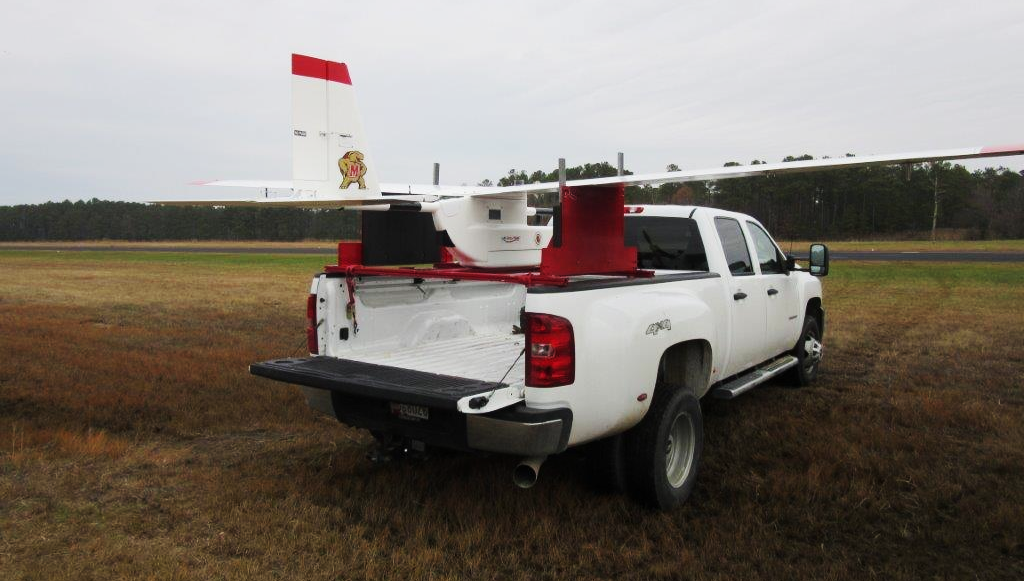
The Talon 240 preparing to launch in back of pickup

FAA Approves UMD UAS Test Site

The University of Maryland (UMD) Unmanned Aircraft Systems (UAS) Test Site, located in California, Md., has received a Certificate of Waiver or Authorization (COA) from the FAA to fly the Talon 240, designed and manufactured by UAV Solutions, Inc. of Jessup, Md. This authorization resulted from the first use of UMD’s airworthiness process, the only known university airworthiness process that is modeled after the U.S. Navy’s rigorous standards for ensuring the safety and reliability of its manned and unmanned aircraft.

The University of Maryland (UMD) Unmanned Aircraft Systems (UAS) Test Site conducted flight operations with the Talon 240, a 140-pound UAS with a 20-foot wingspan, at Crisfield Airport in Somerset County, Md., on December 5, successfully proving the operational processes and procedures required to fly larger UAS.
“We can’t overstate the significance of our operations today,” Tony Pucciarella, Director of
Tony Pucciarella @TPucciarella
Operations for the Test Site
[@TPucciarella] said. “We verified not only our operational and safety procedures, but also successfully worked with our partners to ensure the system’s airworthiness; the first step in the FAA’s rigorous Certificate of Waiver or Authorization (COA) process.”
The airworthiness process the UMD UAS Test Site uses is one Mr. Pucciarella, a recognized expert in unmanned systems, developed based on more than 25 years working in and with the Navy. The process involves having each component of the system verified by a Subject Matter Expert with final airworthiness certified by the UMD Research Department.
The University of Maryland (UMD) Unmanned Aircraft Systems (UAS) Test Site, located in California, Md., has received a Certificate of Waiver or Authorization (COA) from the Federal Aviation Administration (FAA) to fly the Talon 240, designed and manufactured by UAV Solutions, Inc. of Jessup, Md. This authorization resulted from the first use of UMD’s airworthiness process, the only known university airworthiness process that is modeled after the U.S. Navy’s rigorous standards for ensuring the safety and reliability of its manned and unmanned aircraft.

The University of Maryland Unmanned Aircraft Systems Test Site is a part of the Mid-Atlantic Aviation Partnership with Virginia and New Jersey under the FAA UAS Test Site program. The UAS airfields partnering with the University of Maryland include  NAS: Patuxent River, Crisfield Airport, and Wallops Flight Facility.
Headquarters for the University of Maryland’s site is at the St. Mary’s County Regional Airport. The Test Site recently received its first FAA Certificate of Authorization (COA). The COA approves UMD UAS Test Site operations.
The first approved operation for the UMd test site allowed the 20 foot wingspan Talon 240 manufactured by UAV Solutions, Inc. based in Jessup, MD, to launch the first UAV from the site’s Crisfield- Somerset County Airport Dec. 5, 2014.


Sunday, January 4, 2015

NASA SMAP.Satellite's Spinning Lasso to Map Soil Moisture

The SMAP Spacecraft and Antenna
Daily Satellite News - NASA...How Does A Satellite's Spinning Lasso Determine The Moisture In The Soil? With An Extraordinary Antenna
[SatNews]
Launching in January 2015, NASA's Soil Moisture Mapping satellite (SMAP) will track water in the soil. Data gathered with help forecast weather, floods, drought, crop yield and landslides - all from outer space.
"We call it the spinning lasso," said Wendy Edelstein of NASA's Jet Propulsion Laboratory, Pasadena, California, the SMAP instrument manager. Like the cowboy's lariat, the antenna is attached on one side to an arm with a crook in its elbow. It spins around the arm at about 14 revolutions per minute (one complete rotation every four seconds). The antenna dish was provided by Northrop Grumman Astro Aerospace in Carpinteria, California. The motor that spins the antenna was provided by the Boeing Company in El Segundo, California."We call it the spinning lasso." ..."that the mesh doesn't hang up on the supports and tear when it's deploying—all of that requires very careful engineering. We test, and we test, and we test some more. We have a very stable and robust system now."
Scheduled for launch on January 29, 2015, NASA's Soil Moisture Active Passive (SMAP) instrument will measure the moisture lodged in Earth's soils with an unprecedented accuracy and resolution. The instrument's three main parts are a radar, a radiometer and the largest rotating mesh antenna ever deployed in space.


SMAP : Mission Description
Objectives: SMAP will provide global measurements of soil moisture and its freeze/thaw state. These measurements will be used to enhance understanding of processes that link the water, energy and carbon cycles, and to extend the capabilities of weather and climate prediction models. SMAP data will also be used to quantify net carbon flux in boreal landscapes and to develop improved flood prediction and drought monitoring capabilities. >> science
Observatory: The SMAP observatory employs a dedicated spacecraft with an instrument suite that will be launched on an expendable launch vehicle into a 680-km near-polar, sun-synchronous orbit, with equator crossings at 6 am and 6 pm local time.
Instrument: The SMAP instrument includes a radiometer and a synthetic aperture radar operating at L-band (1.20-1.41 GHz). The instrument is designed to make coincident measurements of surface emission and backscatter, with the ability to sense the soil conditions through moderate vegetation cover. The instrument measurements will be analyzed to yield estimates of soil moisture and freeze/thaw state. The measurement swath width is 1000 km, providing global coverage within 3 days at the equator and 2 days at boreal latitudes (>45 degrees N). >> more

 SMAP : Instrument Specifications

Radar

  • Frequency: 1.26 GHz
  • Polarizations: VV, HH, HV (not fully polarimetric)
  • Relative accuracy (3 km grid): 1 dB (HH and VV), 1.5 dB (HV)
  • Data acquisition:
    • High-resolution (SAR) data acquired over land
    • Low-resolution data acquired globally

Radiometer

  • Frequency: 1.41 GHz
  • Polarizations: H, V, 3rd & 4th Stokes
  • Relative accuracy (30 km grid): 1.3 K
  • Data collection:
    • High-rate (sub-band) data acquired over land
    • Low-rate data acquired globally

Antenna

  • Conically-scanning deployable mesh reflector shared by radar and radiometer
  • Diameter: 6 meters
  • Rotation rate: 14.6 RPM
  • Beam efficiency: ~90%
  • Spatial Resolution:
    • Radiometer (IFOV): 39 km x 47 km
    • SAR: 1-3 km (over outer 70% of swath)
  • Swath width: 1000 km

When to use radiation therapy after Surgery for Prostate Cancer

Czech study Results on using uPSA to determine when to use radiation
after Radical Prostatectomy
Radiation Decision pints
When should the patient and doctor consider salvage radiation therapy? | THE "NEW" PROSTATE CANCER INFOLINK
definitions of some commonly used terms and abbreviations:
  • Aggressive pathology means that the post-op pathology report indicates that cancer was found in one or more of the following places:
    • Outside of the prostate capsule (pathological stage T3a), or
    • In the seminal vesicles (pathological stage T3b), or
    • Locally, but at a distance from the prostate (pathological stage T4), or
    • At the surgical margin, where the surgeon has cut through the cancer — a “positive surgical margin” (PSM).
  • Adjuvant radiation therapy (aRT) start right away.
  • Salvage radiation therapy (sRT) start after BCR.
  • Early salvage radiation therapy (early sRT) after aRT, but before sRT .
  • Wait-and-see .
  • Biochemical recurrence (BCR) post-surgery is now defined as a confirmed PSA ≥ 0.2 ng/ml. .
  • An ultrasensitive PSA (uPSA) test is any PSA test that can reliably detect PSAs below 0.1 ng/ml. While the definition of biochemical recurrence has not been changed, detectable levels of PSA are now as low as 0.001 ng/ml on some commercially available ultrasensitive tests.

Ultrasensitive PSA reliably predicts eventual biochemical recurrence (a UCLA study)

Kang et al. found that a uPSA ≥ 0.03 ng/ml was the optimal threshold value for predicting biochemical recurrence (BCR). Other findings included:
  • uPSA ≥ 0.03 ng/ml was the most important and reliable predictor of BCR. It predicted all relapses (no false negatives: no one was under-treated), and hardly ever predicted relapses incorrectly. Only 2 percent would be over-treated by waiting for this cut-off.
  • It was especially prognostic if found on the first uPSA test after surgery.
  • Even if the first uPSA test was undetectable, any subsequent test where uPSA ≥ 0.03 ng/ml predicted BCR.
  • Other lesser predictors of recurrence were pathologic Gleason grade, pathologic T stage, initial PSA before surgery, and surgical margin status.
  • At 5 years of follow-up, 46 percent of patients had a BCR using the “standard” PSA ≥ 0.2 definition, 76 percent using the PSA ≥ 0.03 definition.
  • Treating when an ultrasensitive PSA level reached 0.03 ng/ml gave a median lead time advantage of 18 months over waiting until PSA reached 0.2 ng/ml.
  • It was necessary to monitor PSA for at least 5 years post-op, and to test at least every 6 months.

Ultrasensitive PSA can reliably predict eventual biochemical recurrence at 2 months after surgery (a Czech study)

A Czech study (Vesely et al.) looked at a group of 116 patients who had PSMs after surgery. Unlike the UCLA study, staging was not a selection criterion. The two studies’ goals were somewhat different. While the UCLA study didn’t start uPSA testing until 3 months after prostatectomy, in this study uPSA testing was begun at 2 weeks post-surgery. Most urologists wait for 3 months because surgery sheds a lot of PSA into the serum, and it takes a while for that excess to clear out. The goal in this study was to find out just how early in time after prostatectomy they could detect a uPSA prognostic for BCR, whereas the UCLA study sought to find out how late in uPSA progression they could detect a PSA prognostic for progression. The Czech cohort had the following characteristics:
  • Only patients with PSMs were included
  • Patients who received aRT or hormone therapy were excluded
  • Pathological stage T3/T4 in 54 percent of patients
  • Gleason score ≥ 7 in 51 percent of patients
  • Initial, pre-surgical PSA ≥ 9.2 in 50 percent of patients
  • Time to first post-op PSA, 14 days
All patients’ PSA levels were measured on days 14, 30, 60, 90, and 180 post-surgery, and at 3-month intervals thereafter; the median follow-up was 31 months.
Vesely et al. found that the uPSA on day 30 had predictive accuracy of 74 percent for recurrence, and reached a maximum of 84 percent by day 60, when the uPSA was 0.04 ng/ml (increases in accuracy afterwards were not statistically significant). The following table summarizes their findings:

Saturday, January 3, 2015

Fixing What Ails The U.S. Patent System: A Modest Proposal

Fixing What Ails The U.S. Patent System: A Modest Proposal
Post written by Scott Dietzen and Joe FitzGerald
Dietzen is CEO of Pure Storage, a $3 billion (value) startup in Mountain View, Calif. FitzGerald is its vice president of legal. 

We propose the following changes be considered to ensure that patents and the patent system help, not hinder, innovation:
  • Shorten patent terms: Patents should only last five years from issuance; for patents related to drugs or medical devices requiring separate regulatory approval, publish the allowed patent application but only issue the patent when regulatory approvals are obtained to sell the drug or device. 
    • Term of patent in the United States - Wikipedia, the free encyclopedia 
    • The original patent term under the 1790 Patent Act was decided individually for each patent, but "not exceeding fourteen years".[8] 
    • The 1836 Patent Act (5 Stat. 117, 119, 5) provided (in addition to the fourteen year term) an extension "for the term of seven years from and after the expiration of the first term" in certain circumstances.[9] 
    • In 1861 the seven year extension was eliminated and the term changed to seventeen years (12 Stat. 246, 249, 16). 
    • The signing of the 1994 Uruguay Round Agreements Act[10] then changed the patent term from seventeen years from the date of issue to the current twenty years from the earliest filing date.
  • If patents must be allowed to be “maintained” beyond year five (not recommended), allow it only once for a short time (two years at most) and charge a much higher amount for it than we do today. The current highest maintenance fee is $7,400 due 11.5 years into the patent term. We would recommend charging an order of magnitude more: at least $75,000, and preferably more.  This will encourage conversion to public domain for the majority of patents.
    Current fees: AIA_Section10_Table_of_Patent_Fee_Changes_1-14-13.xlsx - AC54_Final_Table_of_Patent_Fee_Changes.pdf
  • Use it or lose it: Patent owners, like trademark owners today, should be required to show evidence that they have actually productized their patented invention within a time certain (e.g., 12 months from issuance). If not, then the remainder of the patent term should be forfeited. This approach will police the patent ranks and get rid of stale “paper” patents. Patents could be purchased by others in this time period, and the purchaser could provide the necessary evidence of use to keep the patent live.
  • Tighten up on novelty: Require a clear statement in every patent application from the Patent Examiner explaining exactly why the patent is being issued.  If a party finds an earlier example of the “novel” feature, reexamination/inter-partes review is granted automatically on request of a party challenging the patent.
  • Require acquired patents to be put to use: Allow patents to be sold, but only if the buyer can demonstrate plans to actually use the IP in question as expressed in the “use it or lose it” section above.
  • Unite against patent assertion entities: Communities such as The LOT Network (in which Pure Storage participates) promote innovation by reducing the risk of litigation from PAEs and others who buy patents in today’s current open market. Until systemic changes like those proposed are adopted, the high tech industry needs to take the lead and do what it can to protect innovation. Any company can join LOT and help support innovation by limiting the impact of patents that fall into the hands of patent trolls or others that might use them to create a tax on innovative companies.

Friday, January 2, 2015

Sikorsky SAR S-92 Helicopter shows Iridium Satellite Connectivity for Safe Triage Telemedicine

Sikorsky S-92 helicopter for search and rescue - wicklifeboat02
First Flight For Helicopter Satellite Connectivity Conducted | Aero-News Network
LiveTV Satellite Communications, a Thales company and Greenwich AeroGroup, have achieved another joint milestone in inflight integration by demonstrating their LiveAero connectivity solution on a Sikorsky S-92 helicopter in flight.
LiveTV Satellite Communications and distributor Greenwich AeroGroup were chosen by Sikorsky to install and deliver LiveAero’s system to custom-equipped Sikorsky S-92 helicopters to be used primarily for search and rescue missions. LiveAero is the only true global broadband connectivity
system that is unaffected by helicopter rotors and weather. The system offers
  • three voice and
  • one data/Wi-Fi channels
that can all simultaneously be used for voice, data and compressed video transmission anywhere around the globe on fixed wing and rotorcraft. The system can support critical mission data requirements such as texting, emails, internet surfing, aircraft health monitoring,VPN/Cloud connectivity, patient life signs/triage information and more during all stages of flights, on and offshore.
“We were able to demonstrate in flight that the Safe Triage System has the ability to capture and transmit all vital signs via wireless peripherals directly to emergency medical centers to aid in intelligent diagnosis,” said Thomas Tully, Engineering Project Manager for Sikorsky Aircraft.
[On 400 NM search and rescue missions over the Atlantic, continuous telemedical data exchange will be available between an onboard Triage system and medical centers ashore, potentially saving lives during the 2.5 hour flight time.]
“This confirms that the technology provides the rotorcraft industry with a very stable, high availability data link,” said Thales LiveTV President Glenn Latta.
The Thales breakthrough uses a multi-element seven-panel Iridium’s network of 66 Low-Earth Orbit satellites (LEO) in orbit and manage the bandwidth between satellites. The flight testing included Iridium space vehicle passes at a variety of azimuths, showing continuous connectivity throughout the flight envelope.
phased-array antenna to communicate with


Greenwich Aerogroup

This Press Release entry was posted in Greenwich AeroGroup, news. Bookmark the permalink.

UAV for Christmas, Check Rules before you fly

Homeland Security Today: FAA Launches ‘Know Before You Fly’ Drone Safety Campaign
The ‘Know Before You Fly’ campaign provides prospective UAS operators with the information and guidance they need to fly safely and responsibly. The effort is being spearheaded by the Association for Unmanned Vehicle Systems International (AUVSI), Academy of Model Aeronautics (AMA) and the Small UAV Coalition in partnership with the FAA.

“There is a lot of excitement and enthusiasm around UAS, and the technology is becoming the must-have holiday gift,” said Michael Toscano, President and CEO of AUVSI. “The ‘Know before You Fly’ campaign fills a critical education gap just in time for the holiday season. We want to ensure that all prospective operators have the tools they need to fly safely and responsibly.”


FAA And Drone Industry Partners Launch 'Know Before You Fly' Campaign | Popular Science

Unmanned Aircraft Systems
FAA AC 91-57 MODEL AIRCRAFT OPERATING STANDARDS.pdf
 The new UAV may have lots of capabilities, but it is treated as a model aircraft, and subject to existing rules. If you want to do anything outside those limits, e.g. make money, an FAA COA is required, or get a waiver like the Motion Picture Companies.

That Drone Show on TV News | Drone-RSS.com


Dave Oneal and Sarah attended the Drones for the Holidays event on Jan.3.2015 at our sponsor Go Professional Cases headquarters. It was a great day of meeting new friends, seeing old friends, and watching the public learn about how to fly drones safe. We also were featured on the TV News about the event as well. Hope this helps the public and the media realize that Drones are Good.

Previously

spendergast: FAA takes Heat on UAV Waivers to Hollywood 
spendergast: FAA Grounds USF Plan To Educate Students With UAV's 
FAA awards further UAV exemptions - 12/15/2014 - Flight Global
 

Cloud Seeding UAV tested at Nevada Site

Western Research Team Builds Drought-
Fighting Drone To Seed Rainclouds
| sUAS News
Accuweather: Drones Offer New Horizon, Solutions for Weather

Could Drones Help Make Clouds Give Us Rain? | Co.Exist | ideas + impact

UAS Latest News | Reno-Tahoe International Airport

Cloud Seeding UAV in California | UAS VISION

Cloud Seeding for Snowfall Enhancement: Concepts, Evidence of Effects and New Evaluation Techniques - Tilley.pdf

Drones could soon help communities suffering from extreme drought. Meteorologist Jeff Tilley tells CBS News they could help produce billions of gallons of additional water each month through a process called cloud seeding.


Drones Offer New Horizon, Solutions for Weather Modification
Cloud seeding is a more common practice internationally than within the United States. China is known to use the technique frequently. The Nevada government is hoping to break into the global weather modification market by working with this new technology.
Tilley and his team are working closely with the FAA to operate as a test facility for the cloud-seeding operations as well as researching other weather technologies to "increase the observational net," he said.
"The potential market for the technology is substantial bigger than the current cloud-seeding operational community," Tilley said. Entities within the U.S. and other countries would use the technology for whatever precipitation they need who currently cannot afford to use the laborious, aging technology available now.

previously:

spendergast: Status of The FAA UAV Test Sites

USACE Jacksonville seeks small business sources for CADD/GIS and Survey Support


C--Sources Sought - Indefinite Delivery Contract for Architect and Engineering (A-E) Services for Remote Sensing, Surveying, and Mapping Services to support the Jacksonville District and USACE - W912EP-15-Z-0004 - Federal Business Opportunities: Opportunities

: W912EP-15-Z-0004
: Sources Sought
: Added: Dec 31, 2014 9:35 am

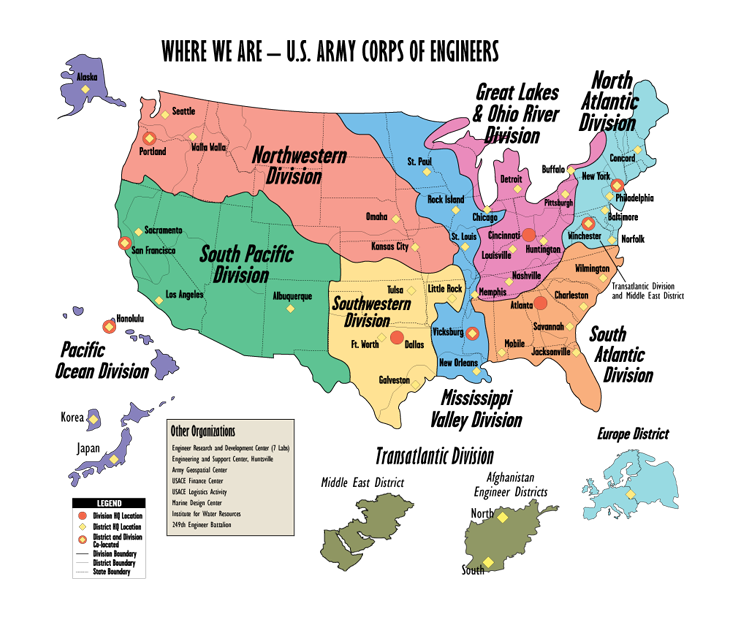
USACE Divisions & Districts
USACE Geospatial Platform
The Jacksonville District of the US Army Corps of Engineers is planning work that will consist of
remote sensing, CADD/GIS mapping services, and topographic, geodetic, property/boundary, and hydrographic surveying to support planning, engineering design, construction, operations, and maintenance of civil works projects. Some of the services are of the following types:
LIDAR
Hyper-spectral Cube
Side scan sonar

The primary purpose of this proposed contract is to provide services for projects located within the geographic boundaries of the Jacksonville District area of responsibility. The Jacksonville District's area of responsibility includes Florida, the Commonwealth of Puerto Rico and the Antilles. Secondarily, the contract may be used to provide services outside of the geographic boundaries of the Jacksonville District. The contractor will have the right to refuse orders for services to be performed outside the geographic boundaries of the Jacksonville District. The anticipated contract will be an Indefinite-Delivery, Indefinite-Quantity contract for a period of one year from date of award, with options to extend for three additional years; not to exceed a total of four years. Maximum order limit is anticipated to be $4,500,000 for the life of the contract, including options.

Jacksonville District – Unmanned Aerial Vehicle (UAV)


The NOVA Unmanned Aerial Vehicle, also known as the NOVA UAV, offers the Corps a low-cost method of obtaining pictures from the air for a variety of applications. The NOVA weighs 11 pounds, which includes its payload of a high-resolution camera, its on-board computer, and a GPS system. A pilot controls the takeoff and landing process. When the plane is in the air, it is guided by computer.