Monday, January 12, 2015

Gas Buddy 2015 Price forecast

GasBuddy Releases Fuel Price Outlook For 2015

2015 gas prices could average $2.64, lowest since 2009

GasBuddy Releases 2015 Fuel Price Outlook - Gasbuddy Gas Prices
GasBuddy today released its 2015 forecast for gasoline and diesel prices to help its users plan for the year ahead, and to understand factors that will be fueling price changes in 2015.

The Fuel Price Outlook, the fourth year GasBuddy has created such a forecast, calls for a yearly national average of $2.64/gallon, a far cry from 2014's yearly national average of $3.34/gallon. In addition to a lower national average, GasBuddy's forecast sees just one month in which the national average may breach $3/gal: May, while January will likely see the lowest monthly average of the year.

Read more at https://blog.gasbuddy.com/posts/GasBuddy-Releases-2015-Fuel-Price-Outlook/1715-596687-2826.aspx#5A7I30bTvYUQb50w.99

2015forecast.pdf

Evolving Wireless Services compete for spetrum

Wireless Coexistence (.PDF Download) | Microwaves & RF

To get an idea of just a few of the competing wireless standards, the reference “Wireless Coexistence” displays many of the common standards that are used today, and a few that we may see in the near future. In the reference, a color-coded chart provides a spatially accurate frequency mapping of the different operator bands of these common standards. A straight-edge can be used to see what different operator bands overlap. A rough and fine detail frequency mapping is provided
along with tables for each of the operator bands’ band number, uplink/downlink frequency, and bandwidth. All the frequencies represented in the tables are the center frequencies of the operator
bands.


Services mapped include:

  1. FDD LTE
  2. TDD LTE
  3. CDMA
  4. GSM
  5. FDD UMTS
  6. TDD UMTS
  7. ZigBee
  8. BlueTooth
  9. UWB
  10. WIFI
    1. 2.4 GHz WIFI
    2. 3.6 GHz WIFI
    3. 5 GHz WIFI
    4. 60 GHZ WIFI
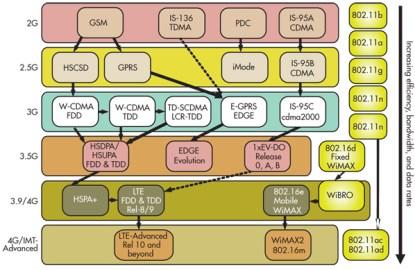
Comparison of wireless data standards - Wikipedia, the free encyclopedia


In the evolution of wireless cellular standards,
all paths eventually lead to some form of
LTE or a WiMAX alternative
MathWorks LTE System Toolbox for MATLAB | EE Times


DHS IG Report criticizes CBP UAS program

Homeland Security Today: ‘CBP Drones are Dubious Achievers,’ Inspector General Report States


Video: 'No evidence' costly drones help secure border, Inspector General says | 89.3 KPCC 

DHS Inspector General John Roth called the drone program a "dubious achiever" and said it has fallen far short of being an asset to the effort to secure the nation's borders.
Roth said he sees "no evidence that the drones contribute to a more secure border, and there is no reason to invest additional taxpayer funds at this time."
Some of the Inspector General's findings:
  • Drone surveillance was credited with assisting just 2 percent of illegal border crossers. In an audit of the apprehensions near Tucson, the drones assisted in just 2,000 of the 120,000 crossers captured by DHS. 
  • The actual cost of flying unmanned aircraft was far higher than the $2,500 per hour DHS reported: When pilot salaries and equipment costs were included the cost was $12,000 an hour.

OIG-15-17 - U.S. Customs and Border Protection's Unmanned Aircraft System Program Does Not Achieve Intended Results Dec14.pdf

What We Found

Although CBP’s Unmanned Aircraft System program contributes to border security, after 8 years, CBP cannot prove that the program is effective because it has not developed performance measures. The program has also not achieved the expected results. Specifically, the unmanned aircraft are not meeting flight hour goals, and we found little or no evidence CBP has met its program expectations. We estimate it costs $12,255 per flight hour to operate the program; CBP’s calculation of $2,468 per flight hour does not include all operating costs. By not recognizing all operating costs, CBP cannot accurately assess the program’s cost effectiveness or make informed decisions about program expansion. In addition, Congress and the public may be unaware of all the resources committed to the program. As a result, CBP has invested significant funds in a program that has not achieved the expected results, and it cannot demonstrate how much the program has improved border security. The $443 million CBP plans to spend on program expansion could be put to better use by investing in alternatives.

What We Recommend

We made four recommendations 

  1. conduct an independent study before acquiring more unmanned aircraft, 
  2. lift the limitations on [VADER] radar sensor operations, 
  3. establish attainable goals and performance measures, and 
  4. gather and report all program costs.

CBP Response to OIG UAS Draft Report FINAL_0.pdf

CBP Response

CBP concurred with one recommendation and concurred in principle with the remaining three recommendations. 


U.S. Customs and Border Enforcement rejects much of the IG's report, saying the audit used faulty accounting.

US border agency halts UAS fleet expansion plans - 1/7/2015 - Flight Global
The US Customs and Border Protection (CBP) agency no longer plans to acquire 14 more medium altitude unmanned air systems and faces stinging new criticisms about the effectiveness of the current fleet of 10 aircraft.
The agency’s fleet – comprised of unarmed land and maritime surveillance versions of the General Atomics Aeronautical Systems Predator B – are so restricted by budget, operational and weather constraints that the aircraft have completed 22% of planned flight hours, according to the report by the Office of Inspector General (IG).
Moreover, an $8 million sensor – the Northrop Grumman vehicle and dismount and exploitation radar (VADER) – is not being used properly, says the IG report. Although VADER has detected thousands of suspected illegal immigrants after they have crossed the border, it is not being used by the CBP for the strategic purpose of tracing their routes back to where they crossed the border.
As a result, the IG recommends that the CBP invest $443 million on more useful purposes than expanding the UAS fleet to 24 aircraft.

Customs and Border Patrol UAS Predator-B
Customs and Border Protection Drones

LiveLeak.com - DHS built domestic surveillance tech into Predator drones


Previously


Saturday, January 10, 2015

NDAA directs space security program to plan offensive/defensive operations

The End of Sanctuary in Space — War Is Boring — Medium

Congress has included language in the National Defense Authorization Act for the 2015 fiscal year, the primary piece of legislation that authorizes and directs the activities of the U.S. military, calling on the U.S. national security space community to report to Congress how it plans to deter and defeat adversary attacks on U.S. space systems.

The NDAA language requires the Secretary of Defense and the Director of  National Intelligence to produce a study on the role of offensive space operations, and specifies that the majority of the $32.3 million that Congress gave to the Space Security and Defense Program in 2015 must be used for “the development of offensive space control and active defensive strategies and capabilities.”
The NDAA language does not stipulate what is meant by offensive or active defensive capabilities, but when combined with recent academic writings  from within the U.S. military, it suggests that America’s strategy for protecting its satellites is taking a more aggressive turn.


The National Security Space Strategy is a pragmatic approach to maintain  he advantages derived from space while confronting the challenges of an evolving space strategic environment. It is the first such strategy jointly signed by the Secretary of Defense and Director of National Intelligence. The themes of the NSSS are reflected in the DOD Strategic Guidance and are being implemented by the DOD Space Policy and other efforts. 

CMU wins FHWA contract for Advanced, Low-Cost Snowplow Visual Guidance System


ASP features include a main computer, human-machine interface,
forward radar sensors, and magnetometers.
Advanced, Low-Cost Snowplow Visual Guidance System

: DTFH6114R00035

: Award

: January 8, 2015

: DTFH6115C00004

: $1,499,669

: Carnegie Mellon University
: Added: May 01, 2014 1:42 pm

Synopsis - Advanced, Low-Cost Snowplow Visual Guidance System

The Federal Highway Administration (FHWA) has a requirement to conduct highly specialized research and develop a prototype low-cost, high-accuracy, visual guidance system for snowplow operators. The conditions for intended use are low and zero visibility environments such as encountered during blizzards, rural nighttime operations, super-cooled fog, and other high visual impairment situations. The effort will include gathering/synthesizing data, distilling this data to parse out technology applicable to the project goals, and designing and assembling an operational prototype unit that will be ready for further validation, enhancement and field use. To successfully complete this project, expertise will be required in diverse fields, including:

  • digital imaging, 
  • digital multidimensional mapping,
  • global positioning systems (GPS), 
  • radar/LiDAR/forward-looking infrared-based (FLIR) sensing, and 
  •  related emerging/existing technologies. 
Experience will also be needed in advanced digital imaging and displays, including

  • augmented reality, 
  • virtual reality, 
  • synthetic vision, and 
  • advanced user displays such as  heads-up displays (HUDs), 
  • visors and other wearable technology.

Related Links


TRANSPORTATION HUMAN FACTORS, 2(3), 247-264
Aaron Steinfeld (now at CMU) and Han-Shue Ian
Partners for Advanced Traffic and Highways (PATH}
University of California, Berkeley
A system to aid snowplow operators during adverse, low-visibility conditions was developed using a quick, low-cost iterative design process The system provided display-independent visual information on lane edges, late ml position, and potential forward collisions Short practice curves were seen on a prototype lateral assist system with drivers achieving a steady state within 3 trials. The subsequent
operational system resulted in positive driver feedback and quick learning periods Drivers had positive impressions regarding ease of use, appeal, and safety Behavior data showed that the shott leaming curves seen with the prototype could also be associated with the operational system. Using the framework of this snowplow problem, an iterative design process is also described that is robust to variations in available time and resources Application specific and process design lessons are
also discussed.

Smartphone and Future of Medicine


Smartphone App for Personalized Drug Dose Computations | LSI

“Reality Mining” App Alerts Docs of Illness

The Future of Medicine Is in Your Smartphone - WSJ

With the smartphone revolution, an increasingly powerful new set of
tools—from attachments that can diagnose an ear infection or track heart
rhythms to an app that can monitor mental health—can reduce our use of
doctors, cut costs, speed up the pace of care and give more power to
patients. Digital avatars won’t replace physicians: You will still be
seeing doctors, but the relationship will ultimately be radically
altered.


The key to better health care may already be in your pocket... and it's not your wallet - Rock Center with Brian Williams

Dr. Eric Topol is the energetic chief academic officer of Scripps Health, a prominent cardiologist and the foremost figure in the field of wireless medicine. He believes the future of health lies in our own hands, namely in our smart phones and other portable electronic devices.  According to Topol, “the smart phone will be the hub of the future of medicine.  And it will be your health-medical dashboard.”

BBC - Future - Should we diagnose rare diseases with smartphones?
As fear of the Ebola virus escalates, Eric Topol thinks that we’re missing an important weapon. And you just need to reach into your pocket to find it. “Most communicable diseases can be diagnosed with a smartphone,” he says. “Rather than putting people into quarantine for three weeks – how about seeing if they harbour it in their blood?” A quicker response could also help prevent mistakes, such as the patient in Dallas who was sent home from hospital with a high fever, only to later die from the infection.
....
Topol, meanwhile, thinks that smartphones should speed up Ebola diagnosis itself. Current tests requires specialist labs that aren’t readily available in some of the hardest hit zones, but one technique – “polymerase chain reaction” – could be performed by a cheap add-on to a mobile phone. PCR works by amplifying traces of the pathogen’s DNA in a patient’s blood sample and tagging them with a fluorescent dye. The phone’s camera can then detect the glowing dye to determine whether the virus was present in the sample.
“Ebola only has five genes – so it’s tiny but its presence in the blood should be easy to detect,” says Topol. Biotech firm Biomeme, based in Philadelphia, is already on the case. Maria Chacon Heszele and Jesse vanWestrienen, who are working on the system, point out that their portable PCR could screen someone in less than two hours from a single finger prick. It also has a low false-positive rate – just three per thousand cases.

x

Review

Siddhartha Mukherjee, author of The Emperor of All Maladies: A Biography of Cancer“What happens when you combine cellular phone technology with the cellular aberrations in disease? Or create a bridge between the digital revolution with the medical revolution? How will minute biological sensors alter the way we treat lethal illnesses, such as heart attacks or cancer? This marvelous book by Eric Topol, a leading cardiologist, gene hunter and medical thinker, answers not just these questions, but many many more. Topol’s analysis draws us to the very frontlines of medicine, and leaves us with a view of a landscape that is both foreign and daunting. He manages to recount this story in simple, lucid language—resulting in an enthralling and important book.”

Eric Topol | Medscape Editor in Chief

Top Free in Medical - Android Apps on Google Play
Top 15 free Android medical apps for healthcare professionals | iMedicalApps
  1. Medscape
  2. Epocrates
  3. Skyscape
  4. Evernote  
  5. Calculate by QxMD
  6. MedPage Today
  7. Harvard School of Public Health News
  8. Monthly Prescribing Reference (MPR)
  9. Standard Dictations
  10.  USPSTF ePSS (electronic preventive services selector)
In-Depth: Top 200 paid iPhone apps for medical professionals | mobihealthnews


Friday, January 9, 2015

DMS&T Call to DOD and Industry for manufacturing technology

Defense-Wide Manufacturing Science & Technology (DMS&T)-Call to DOD and Industry - Federal Business Opportunities: Opportunities

: RFI-RQKM-2015-0015

: Special Notice
: Added: Jan 07, 2015 10:54 am

The Defense-Wide Manufacturing Science & Technology (DMS&T) Program invites responders from DOD and defense industrial base, to
include OEMs and supply chain small businesses, to provide information
for developing technical programs addressing manufacturing technology
for fiscal years 2016 and 2017. There are four technology focus areas
currently under consideration for DMS&T investment. Programs
addressed may span up to 36 months.

1. Advanced Propulsion
2. Radar Affordability and Electronic Warfare (EW)
3. Transparent Ceramics
4. Pervasive Technologies

 Related Links:


Thursday, January 8, 2015

Penn finds Older men with prostate cancer benefit from radiation plus hormone therapy

Older men with prostate cancer benefit from radiation plus hormone therapy - Medical News Today
Two landmark clinical trials have shown that radiation plus hormone therapy produces a large and significant improvement in survival in younger men relative to hormone therapy alone, but until now there has been no comparable research on treatment for older men with advanced prostate cancer.
Addressing this question for the first time, Penn's research team compared the combination of radiation plus hormone therapy versus hormone therapy alone among 31, 541 men with prostate cancer ranging in age from 65 years to 85 years.
  • Among men age 65 to 75 years old, radiation plus hormone therapy was associated with a reduction in prostate cancer deaths of 57 percent relative to hormone therapy alone (from 9.8 percent to 4.4 percent of patients at 7 years follow up). 
  • Similarly, among men age 76 to 85 years old, radiation plus hormone therapy was associated with a reduction in prostate cancer deaths of 49 percent relative to hormone therapy alone (from 9.8 percent to 5.0 percent of patients at 7 years follow-up). 
  • In both groups, radiation plus hormone therapy was also associated with about one-third fewer deaths from any cause.
  • Importantly, the clinical trials have shown that the side effects of radiation plus hormone therapy are very acceptable relative to hormone therapy alone.
"Older men with aggressive prostate cancers should know that the combination of radiation plus hormone therapy is both tolerable and effective in curing prostate cancer," said Bekelman.
In addition to offering new evidence for older men, Bekelman's research also demonstrates that the prior clinical trial findings for younger men apply in the "real-world" of routine clinical practice. Only three percent of cancer patients participate in clinical trials; thus, confirming that treatments work in real-world care is a crucial aspect of translating medical evidence to clinical practice.
Bekelman's study is an example of patient-centered cancer comparative effectiveness research, which provides reliable, useful information to help individual patients make informed cancer care decisions and improve cancer care outcomes.
The Penn-led study examined radiation treatment and hormone therapy in the Surveillance Epidemiology and End Results (SEER) Medicare database. SEER collects data from population-based cancer registries that cover 26 percent of the U.S. population and Medicare, which covers 97 percent of the U.S. population 65 years of age or older. Patients received treatments not by random assignment but as part of their normal clinical care. Bekelman's team utilized specialized analysis techniques to mimic randomized clinical trials in data from routine care and to identify which treatments are best for men of different age groups and cancer severity.

Penn Study: Radiation Plus Hormone Therapy Prolongs Survival for Older Men with Prostate Cancer
Prolonged survival for older men with prostate cancer - CareAcross

Clinical outcome: 1/3 fewer deaths

Penn's research team compared the combination of radiation plus hormone therapy versus hormone therapy alone among 31,541 men with prostate cancer ranging in age from 65 years to 85 years.
  • Among men aged 65 to 75 years old, radiation plus hormone treatment was associated with a reduction in prostate cancer deaths of 57% relative to hormone treatment alone.
  • Similarly, among men aged 76 to 85 years old, radiation plus hormone treatment  was associated with a reduction in prostate cancer deaths of 49% relative to hormone treatment alone.
In both groups, radiation plus hormone treatment was also associated with about 1/3 fewer deaths from any cause.
Patients received treatments not by random assignment but as part of their normal clinical care. Bekelman's team utilized specialized analysis techniques to mimic randomized clinical trials in data from routine care and to identify which treatments are best for men of different age groups and cancer severity.

Related links:

Patent App for MIMO Transceiver Vehicular Radar with multi-phase/time controlled chirps

Radar Transceiver
United States Patent Application: 0150002328
Inventors: Vaucher; Cicero Silveira; (Eindhoven, NL) ; Gehrels; Cornelis; (Nijmegen, NL)
Applicant:
Name City State Country Type

NXP B.V.

Eindhoven

NL
 
Abstract
The application refers to a radar transceiver comprising a set of transmitters (TX1, . . . , TXn) for transmitting radar chirps to targets, a set of receivers (RX 1, . . . , RXn) for receiving reflected chirps from the targets, a timing engine (1) coupled to the set of transmitters (TX1, . . . , TXn) and to the set of receivers (RX1, . . . , RXn) and adapted to transmit a first set of control signals to the set of transmitters (TX1, . . . , TXn) and to the set of receivers (RX1, . . . , RXn). The timing engine (1) is further coupled to a computing unit (4). The timing engine (1) is adapted to receive a second set of control signals generated by the computing unit (4) and transmitted via a bus. The radar transceiver further comprises a sweep control unit (2) coupled to the timing engine (1) and adapted to receive a first control signal and a second control signal from the timing engine (1), the first control signal indicating a precise start time of a chirp and the second control signal indicating a precise reset time for resetting the chirp. The sweep control unit (2) is further coupled to a controlled Phase Locked Loop (PLL) (3) adapted to generate a local oscillator (Master LO) signal which is adapted to be inputted to both each member of the set of transmitters (TX1, . . . , TXn) and each member of the set of receivers (RX1, . . . , RXn).

BACKGROUND OF THE INVENTION

[0002] Radar sensors featuring high angular resolution normally rely on large antenna apertures. This can be achieved with the use of a dielectric lens in front of a small number of antenna elements, or with a large number of receiving (RX) elements in a phased array configuration as e.g. Bosch LRR3. Lens-antenna based techniques have the disadvantage of a small angular field-of-view of +10 degrees, making this approach less suitable for short- and middle-range radar applications where a larger field of view is required i.e. larger than .+-.60.degree. degrees. In the following description the term RX is used to indicate a receiver and the term TX is used to indicate a transmitter, together with their plural forms RXs and TXs, respectively.

[0003] The large RX antenna array, on the other hand, leads to a large sensor physical size which is a drawback in many practical circumstances e.g. placement behind the bumper, etc.

[0004] It has been shown that the application of Multiple Input Multiple Output (MIMO) techniques that combines a relatively small number of RXs e.g. 4 with a small number of TXs e.g. 4 [Feger-2009 `A 77-GHz FMCW MIMO Radar Based on an SiGe Single-Chip Transceiver`, Reinhard Feger et al., IEEE TRANSACTIONS ON MICROWAVE THEORY AND TECHNIQUES, MAY 2009, pp. 1020-1035] provides a larger "effective" receiving aperture, effectively the aperture of 16 receiving antennas, without the drawbacks mentioned above, meaning that the field of view is kept relatively large and the physical size is comparable to a small array of 4 RXs. The MIMO technique described above works by sequentially switching the TXs while the RXs acquire and store data, so that a set of measurements for all combinations of TX and RX antennas is obtained after the data acquisition cycle completes [TX1, RX1, RX2, . . . ], [TX2, RX1, RX2, . . . ]. The radar processing is then completed by post-processing the set of measured results for the different TX1, . . . , TXn possibilities.

[0005] An alternative technique for MIMO radar signal acquisition and processing is described in US2012/0001791 and it is shown in FIG. 1. In this application the phase of a TX path TX0 is binary toggled from chirp to chirp, whereas the phase of the second TX path TX1 is kept constant from chirp to chirp. The data acquisition process is simultaneous for TX0 and TX1, instead of sequential as in the method proposed by Feger. The phase toggling in path TX0 allows the signal from the two TXs antennas to be separated in subsequent signal processing steps.
::::
SUMMARY OF THE INVENTION

[0021] Hence, it is a need for an improved radar system.

[0022] It is therefore an object of the invention to provide a radar transceiver system comprising [0023] a set of transmitters for transmitting radar chirps to targets, [0024] a set of receivers for receiving reflected chirps from the targets, [0025] a timing engine coupled to the set of transmitters and to the set of receivers and adapted to transmit a first set of control signals to the set of transmitters and to the set of receivers, the timing engine being further coupled to a computing unit, the timing engine being adapted to receive a second set of control signals generated by the computing unit and transmitted via a bus, [0026] a sweep control unit coupled to the timing engine and adapted to receive a first control signal and a second control signal from the timing engine, the first control signal indicating a start time of a chirp and the second control signal indicating a reset time for resetting the chirp, the sweep control unit being further coupled to a controlled Phase Locked Loop (PLL) adapted to generate a local oscillator signal which is adapted to be inputted to both each member of the set of transmitters and each member of the set of receivers.

[0027] In this way, the chirps generation is precisely controlled by the timing engine and the chirps are generated by the PLL under the direct control of the sweep control unit. Hence, the use of the SPI is avoided in the acquisition mode and the chirps are generated with a more precise timing control.

MIT Offers Free Online Course on Mathematics Applications in Finance

Topics in Mathematics with Applications in Finance | Mathematics | MIT OpenCourseWare

Course Description

The purpose of the class is to expose undergraduate and graduate students to the mathematical concepts and techniques used in the financial industry. Mathematics lectures are mixed with lectures illustrating the corresponding application in the financial industry. MIT mathematicians teach the mathematics part while industry professionals give the lectures on applications in finance.

It's Winter Time at ONR

Rear Adm. Mathias W. Winter
Leadership - Office of Naval Research
Adm. Winter Takes Helm of U.S. Naval Research Efforts | SIGNAL Magazine
News: Full Steam Ahead for Navy Science: Winter Comes to ONR - Office of Naval Research

FOR IMMEDIATE RELEASE: Jan. 5, 2015

By David Smalley
ARLINGTON, Va.— The Office of Naval Research (ONR) has begun a new era, as Rear Adm. Mathias W. Winter—a decorated aviator with advanced degrees in both computer science and national resource strategy—was sworn in as the chief of naval research (CNR).
Winter officially took the helm of ONR, the organization that leads Navy and Marine Corps research efforts, during a change-of-command held on Dec. 30. The ceremony was held at the Pentagon and officiated by the Honorable Sean Stackley, assistant secretary of the Navy (research, development and acquisition).

Winter has served flag tours as the commander, Naval Air Warfare Center Weapons Division, China Lake/Point Mugu, California, assistant commander for Test and Evaluation, Naval Air Systems Command and PEO for Unmanned Aviation and Strike Weapons. In December 2014, he became the 25th chief of Naval Research with concurrent flag responsibilities as director, Innovation Technology Requirements, and Test & Evaluation.


Mobile Base visits Vallejo for repairs in Mare Island Drydock

USNS Montford Point Floated from General Dynamics NASSCO Building Dock


New Navy Ship Makes Appearance in Vallejo | Military.com
There is a celebrity currently visiting Mare Island. Her name is the USNS Montford Point and she has quite a noticeable appearance at 765 feet long --big enough to displace 34,500 tons of water. And she is at Mare Island for some rest and repairs. Designated as the first Mobile Landing Platform ship, the Montford Point is part of a new breed of ship built for the United States Navy, while being modeled after the Alaska-class crude oil carrier design.
:::
"There aren't too many places to park it (in the area)," Christina Snyder, executive vice president of contracts with Mare Island Dry Dock. Mare Island Dry Dock, LLC. operates on an 18+ acre site of land.  The site, located on Mare Island, is the home of both Dry Dock #2 and Dry Dock #3.  Dry Dock #2 is 720 feet long by 96 feet wide,so it is large enough to hold the ship. Both are active concrete graving docks with the largest capacity being a length of 700 feet. Both Dry Docks can accommodate ships under fully loaded conditions.  Mare Island Dry Dock, LLC.  has a secure berthing of up to 1,300 linear feet.
USNS Montford Point, The Navy's New Sea Base

Exclusive Photo: USNS Montford Point, The Navy's New Sea Base
Classified as a Mobile Landing Platform, this 35,000 ton (displacement) converted mega-tanker design will be able to semi-submerge its hull so that no less than three Landing Craft Air Cushion (LCAC) hovercrafts at a time can haul cargo on and off. With individual LCAC "lanes," this mobile pier can move an eye watering amount of cargo and be off to go do it again at another location. Cargo can consist of everything from troops to M1 Abrams main battle tanks, and everything in-between.
While LCACs are coming and going from her starboard side, she can be accepting more cargo from her port side. In this sense the ship is really a mobile pier and many classes of ships, from small craft to the fast moving HSV-2 Swift catamaran to large roll on/roll off logistical ships, can tie up to her and transfer thousands of tons of supplies and material via the her built in cargo ramp. At the bottom of this ramp, and next to the LCAC lanes, there is a large vehicle and cargo deck where material can be staged after before being sent away via hovercraft.
This vehicle and cargo deck area could also work as a large landing deck that can accommodate any helicopter in the American inventory, from the mighty CH-53E Super Stallion to the UH-1Y Venom. When operating aviation assets the ship can carry a large volume of jet fuel and work as a forward arming and refueling point for rotary winged assets.


Mare Island- California’s Gold (704)
After MINSY was BRAC'd in 1998, private companies first tried to repurpose the shipyard facilities for scrapping decommissioned ships, but couldn't compete with Texas yards. Now they focus on ship repair.

New ship repair company to replace existing firm at Mare Island
Mare Island Dry Dock, LLC, recently completed a lease for an undetermined time period for Dry Docks 2 and 3 and will occupy the same 16 acres and existing infrastructure as current tenant Mare Island Ship Yard has, Keadjian said. This company will focus immediately on ship repair work, officials say.
"We've got many things to do to be prepared and as they say in the Navy, 'hit the decks running,' " Mare Island Dry Docks Vice President Steven Park said by phone Monday. "We have been looking for a West Coast, and I do mean West Coast location. We've looked for the last nearly two years for a suitable location."

Visit Mare Island - Historic Mare Island Naval Shipyard MINSY

Wednesday, January 7, 2015

FAA Grants ok to Agriculture and Real Estate Companies for UAV ops - still need COA

Phantom 2 Vision+
eBee
FAA Grants Real Estate, Agricultural UAS Exemptions

The agency gave the exemptions to

Before these exemption approvals, the FAA had granted 12 exemptions to
11 companies in a variety of industries.


Mr. Trudeau’s exemption authorizes him to fly a Phantom 2 Vision + quadcopter to enhance academic community awareness and augment real estate listing videos.
Advanced Aviation Solutions plans to use a fixed-wing eBee Ag UAS to make photographic measurements and perform crop scouting for precision agriculture.


FAA Grants Drone Permits to Agriculture and Real Estate Companies | TIME

Exemptions to the ban on commercial drones were made for Advanced Aviation Solutions in Spokane, Wash., for “crop scouting,” and to Douglas Trudeau of Tierra Antigua Realty in Tucson, Ariz., for enhanced aerial footage of buildings, according to an FAA statement.

CDR Sanchez Pleads Guilty in "Fat Leonard" Bribery Scandal

U.S. Navy Commander Jose Luis Sanchez
Navy Commander Pleads Guilty in Bribery Scandal | NBC 7 San Diego

U.S. Navy Commander Jose Luis Sanchez, 42, admitted to bribery and conspiracy to commit bribery in a plea deal. From 2009 to 2013, Sanchez accepted prostitutes, luxury travel, entertainment  and $100,000 cash from Malaysian contractor Leonard Francis, known in military circles as "Fat Leonard," the plea agreement says. In exchange, Sanchez gave Francis, the CEO of  Glenn Defense Marine Asia (GDMA), classified Navy ship schedules and other proprietary, internal information.

According to the plea deal, Sanchez would forward internal emails to Francis when they mentioned competitors or investigations into overbillings by GDMA, which coordinated and scheduled goods and services for Navy ships coming into port.

Source: http://www.nbcsandiego.com/news/local/San-Diego-Navy-Bribery-Scandal-Jose-Luiz-Sanchez-Fat-Leonard-287700541.html#ixzz3O9nn9XPs

Follow us: @nbcsandiego on Twitter | NBCSanDiego on Facebook
Leonard Glenn Francis, wealthy Malaysian contractor
Navy Was Warned of Contractor at Center of Bribery Inquiry - NYTimes.com
Leonard Glenn Francis, a wealthy Malaysian contractor at the heart of one of the United States Navy’s largest bribery scandals in decades. 
At 6 feet 3 inches and 350 pounds, Mr. Francis hosted dinners at luxury hotels in  Malaysia, Singapore and Hong Kong for senior officers who knew him as Fat  Leonard, dispensing boxes of Cuban cigars and dropping the names of admirals he knew, senior Navy officers said.
But as his reputation for lavish parties spread, so too did warnings about his business practices, according to Navy officials and court documents. Emails obtained by criminal investigators show that from 2009 to early 2011, several ship crews and contracting officials filed complaints about his “gold-plated” fees for fuel, port security and other services. In 2010, the Naval Criminal Investigative Service opened investigations into questionable charges in Thailand and Japan by his company, documents show.
Despite those red flags, in June 2011, the Navy awarded Mr. Francis $200 million in contracts, giving him control over providing supplies and dockside services for its fleet across the Pacific.

US Navy Commander Jose Luis Sanchez Pleads Guilty In Bribery Case - Business Insider
As a US Navy commander, Jose Luis Sanchez helped oversee operations in an area spanning Japan, Russia, Singapore, Australia, and many other countries across Asia. Now, he is the highest-ranking official to plead guilty in a massive bribery scheme that has rocked the Navy.
The bribes that destroyed Sanchez's career and leave him facing a maximum penalty of 20 years in prison are valued at no more than $120,000, according to a plea agreement. That includes payment to prostitutes, $7,500 to travel from Asia to the United States, five days at Singapore's luxury Shangri-La Hotel, and cash.

Previously:

spendergast: Navy Procurement Bribery Scandal Reaches NCIS and top Admirals

Tuesday, January 6, 2015

TEBookConverter | SourceForge.net

TEBookConverter | SourceForge.net

Description

TEBookConverter is an easy to use ebook converter that uses Calibre.
  • Supported input formats are cbz, cbr, cbc, chm, djvu, docx, epub, fb2, html, htmlz, lit, lrf, mobi, odt, pdf, prc, pdb, pml, rb, rtf, snb, tcr, txt, txtz.
  • Supported output formats are azw3, epub, fb2, oeb, lit, lrf, mobi, htmlz, pdb, pml, rb, pdf, rtf, snb, tcr, txt, txtz.
You can convert ebooks fast thanks to multithreading.

You may need to run this software as admin in some cases.

This project is currently looking for translators.
TEBookConverter Web Site