Wednesday, October 11, 2017

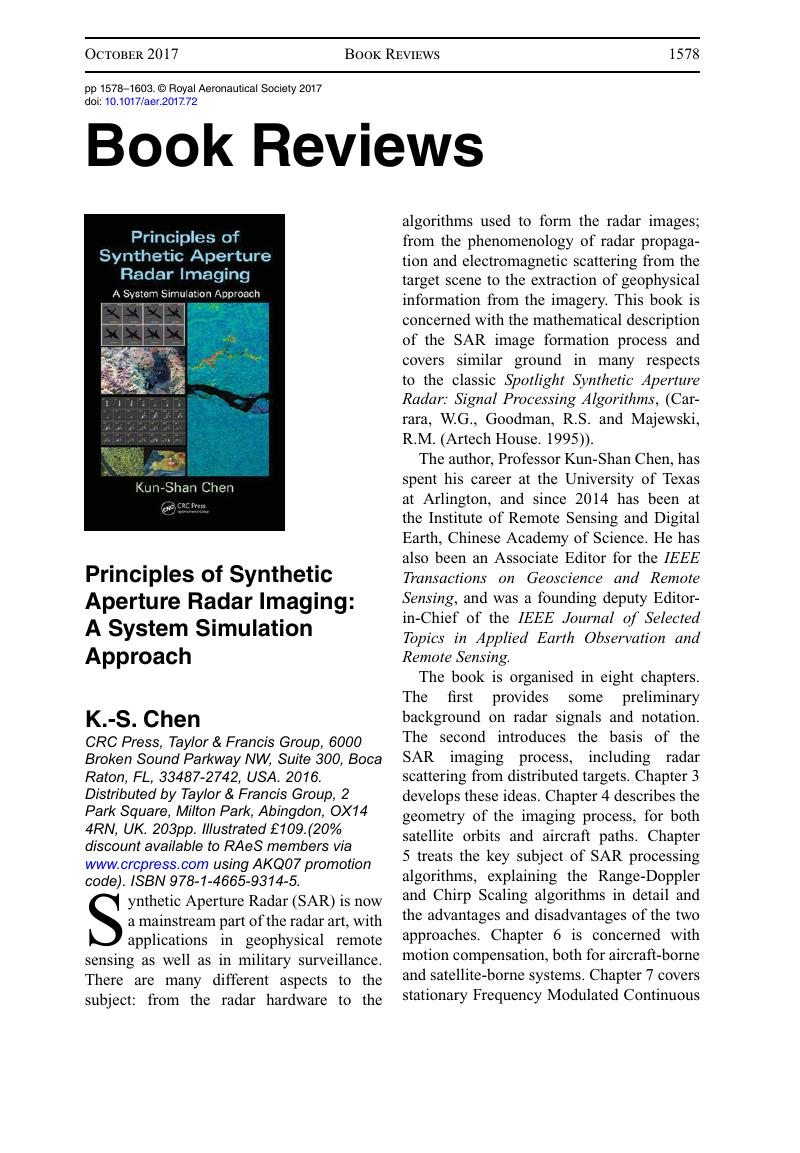
Principles of Synthetic Aperture Radar Imaging: A System Simulation Approach - CRC Press Book

 Principles of Synthetic Aperture Radar Imaging: A System Simulation Approach - CRC Press Book

Principles of Synthetic Aperture Radar Imaging: A System Simulation Approach (Signal and Image Processing of Earth Observations): Kun-Shan Chen: 9781466593145: Amazon.com: Books

Features

  • Includes numerical analysis of system parameters, including platforms, sensor, and image focusing, and their influences
  • Brings a large volume of samples of simulation on various scenarios to help readers resolve their own problems of interest
  • Explains in details the state-of-the-art of space-, air-borne, and ground-based systems, their different technical aspects and challenges to overcome
  • Presents novel processing algorithms and applications to feature extraction, target classification, and change detection

Summary

Principles of Synthetic Aperture Radar Imaging: A System Simulation Approach demonstrates the use of image simulation for SAR. It covers the various applications of SAR (including feature extraction, target classification, and change detection), provides a complete understanding of SAR principles, and illustrates the complete chain of a SAR operation.
The book places special emphasis on a ground-based SAR, but also explains space and air-borne systems. It contains chapters on signal speckle, radar-signal models, sensor-trajectory models, SAR-image focusing, platform-motion compensation, and microwave-scattering from random media.
While discussing SAR image focusing and motion compensation, it presents processing algorithms and applications that feature extraction, target classification, and change detection. It also provides samples of simulation on various scenarios, and includes simulation flowcharts and results that are detailed throughout the book.
Introducing SAR imaging from a systems point of view, the author:
  • Considers the recent development of MIMO SAR technology
  • Includes selected GPU implementation
  • Provides a numerical analysis of system parameters (including platforms, sensor, and image focusing, and their influence)
  • Explores wave-target interactions, signal transmission and reception, image formation, motion compensation
  • Covers all platform motion compensation and error analysis, and their impact on final image radiometric and geometric quality
  • Describes a ground-based SFMCW system
Principles of Synthetic Aperture Radar Imaging: A System Simulation Approach is dedicated to the use, study, and development of SAR systems. The book focuses on image formation or focusing, treats platform motion and image focusing, and is suitable for students, radar engineers, and microwave remote sensing researchers.

Review of principles of synthetic aperture radar imaging a system simulation approach - ks chen

Griffiths, H. (2017). Principles of Synthetic Aperture Radar Imaging: A System Simulation Approach K.-S. Chen CRC Press, Taylor & Francis Group, 6000 Broken Sound Parkway NW, Suite 300, Boca Raton, FL, 33487-2742, USA. 2016. Distributed by Taylor & Francis Group, 2 Park Square, Milton Park, Abingdon, OX14 4RN, UK. 203pp. Illustrated £109.(20% discount available to RAeS members via www.crcpress.com using AKQ07 promotion code). ISBN 978-1-4665-9314-5. The Aeronautical Journal, 1-2. doi:10.1017/aer.2017.72

Tuesday, October 10, 2017

IPCSG FUTURE MEETINGS


·  

October 21, 2017—ADVANCES IN DIAGNOSTICS Fabio Almeida, M.D.
As Medical Director of Phoenix Molecular Imaging and Southwest PET/CT Institute in Yuma, AZ, Dr. Almeida oversees clinics in Phoenix, Yuma, and Tucson, providing his extensive clinical expertise in PET/CT imaging. He continues his research, focused on applied medical informatics with emphasis on imaging and networking systems, optimization of fusion technology, and volumetric tumor assessment for radiation therapy planning. He actively participates in several oncology and neurologic clinical trials and is the principal investigator for a novel Carbon-11 PET agent for prostate cancer imaging. 

previously:

---------------------------------------------------------------------------------------------------------------------------------------------------------------------------------·  

November 18, 2017—ADVANCES IN IMMUNE THERAPY Richard Lam M.D. 
A board-certified internist and oncologist, Richard Lam, MD, has been specializing full time at Prostate Oncology Specialists in the treatment of prostate cancer since 2001. He is the director of clinical research. Dr. Lam has written numerous articles based on his research. He is an active member of the American Society of Clinical Oncology and the American Society of Hematology. Dr. Lam continues to promote prostate cancer awareness and education by giving lectures at various medical conferences and prostate support groups throughout the country. He is particularly interested in utilizing state-of-the-art therapeutics for advanced prostate cancer.

 previously:

---------------------------------------------------------------------------------------------------------------------------------------------------------------------------------·  
· December—no meeting, next meeting in January.

2017-09 IPCSG Meeting:Dr. Brent Rose - Advances in Radiation Oncology for the Treatment of Prostate Cancer


Advances in Radiation Oncology for the Treatment of Prostate Cancer
 
 Brent S. Rose, MD, Radiation Oncology, UC San Diego
 1.  Focal Radiotherapy Boost of Dominant Intraprostatic Nodule
Prostate cancer is usually multifocal, with a dominant nodule (tumor), and one or more other smaller tumors.  So “whole-gland” radiotherapy has been necessary up to now to treat all of the cancer.  Often after radiation, the cancer comes back in the dominant nodule area, so it is hypothesized that that nodule reflects the most aggressive part of the tumor.  A new goal is to increase the dose to that highest risk area, without significantly increasing the dose to surrounding tissue.  Some details, such as how much boost to give, are still being worked out on a case by case basis.  But use of this approach is expected to increase.

2.  Treatment Response Assessment with MRI
When a patient is being treated for prostate cancer, it is important to learn quickly whether the treatment is working.  This could allow for dose escalation (or even de-escalation), based on whether the response of the tumor(s) to the treatment is favorable or not.
Multiparametric MRI is the best way of imaging localized prostate cancer.  The key parameters are T2 (for anatomic detail), Dynamic Contrast Enhancement (showing tumors because of their greater blood supply resulting in fast uptake of the contrast agent), and Diffusion Weighted Imaging (showing areas of dense tissue, which signifies a tumor – and the density correlates with Gleason scores!).  At UCSD, an advanced diffusion weighted imaging technique called Restriction Spectrum Imaging has been developed.  The anatomic detail of the T2 parameter is overlaid on the DWI result, and this gives a precise understanding of where the tumor is, and is very helpful in planning for focal radiation treatment.

3.  Sexual Potency-Preserving Radiotherapy
Erectile dysfunction is one of the most significant complications of prostate cancer treatment.  One of the common pathways for escape of the cancer from the prostate is along the nerves of the “neurovascular bundle.”  So surgery often involves cutting these nerves to get out all the cancer.  That negatively affects sexual potency.  The (typically smaller) impact of radiation on erectile function is likely due instead to irradiation of the vasculature (blood vessels) of the penis, resulting in decreased blood flow.  It’s as though the radiation causes accelerated aging, leading to buildup of plaque and less blood flow to create erections.
By directing the radiotherapy appropriately, with the aid of an MRI scan, the blood vessels can be spared much more precisely than in the past when only CT scans (which don’t show prostate anatomy well) were used for planning.  With this precise targeting, critical normal structures can be avoided, and the need for ADT (hormone therapy) may be avoided or reduced.  Although the radiation field typically includes the neurovascular bundle, the nerves are relatively resistant to radiation, so are not adversely affected very much.  Sexual potency is more often preserved compared to results after surgery.  See European Urology, 72 (2017) 617-624.

 4.  Treatment of Oligometastatic Disease: 
This is prostate cancer with 1-4 metastases, typically in the lymph nodes or bones.  Preliminary literature reports suggest that aggressive treatment may improve survival.  In a case example given, a bone scan gave (as always) poor sensitivity and specificity, but an F18-Fluciclovine (“Axumin,” radiolabeled amino acid) PET scan showed a distinct area that could be treated with radiation.  Other agents can also be used in PET imaging, including C-11 and PSMA tracers, but they are not FDA approved, so insurance won’t pay for them [but see last month’s Q&A for PSMA at UCSF paid for by Medicare].  In the case shown, MRI gave very distinct identification of the metastatic lesion, near the prostate, and the patient was treated with stereotactic radiation therapy (a short course of high-dose radiation).  In some cases, prostatectomy may be done in addition.  ADT may follow for a time, possibly including abiraterone (Zytiga).

UCSD has opened a study for cancer patients with high-risk or known metastatic disease, with a goal to test the accuracy of whole-body MRI to identify sites of metastatic disease. 

Questions: 
If on Lupron, can one use the advanced diagnostic tests (PET with tracer)?  Yes, but … Lupron tends to put the cancer to sleep, so it’s harder to see the lesions.  It’s still possible to find them if looking carefully.
When should one use proton therapy instead of IMRT?  Studies are underway, but in general results are very similar.  Side effects are about the same.  Protons don’t pass all the way through the body, so that’s an advantage for some cancers, like brain cancer or the spine (but not demonstrably so yet for prostate cancer).  It takes a very powerful (large!) machine to accelerate the protons, and this physically interferes with following the therapy by daily imaging.  However, improvements are being made. 
PIRADS scores vs. Gleason Scores?  Not equivalent, but they tend to track together.
MRI after surgery – does it correlate with PSA level?  Usually MRI after surgery is not very helpful, because any remaining tumor is likely very small and hard to see, especially in and around scar tissue.  Axumin or C-11 scan is likely to be more sensitive in that case.
SpaceOAR (gel injected between prostate and rectum before irradiation) pros and cons?  Great in theory, but how much it really matters, and what the side effects are, are still not fully determined.  A very slight benefit has been shown in published studies.  But, a few patients got fistulas.  That’s serious, though rare, and not proven if caused by the injection rather than something else.  At UCSD, they find the gel is not necessary because the rectum is not significantly damaged even when the gel is not used.  Note:  It’s not covered by some insurance, and costs up to $5,000.
Qualifications for the whole-body MRI research study?  They are very broad: having high risk for metastatic disease (newly diagnosed) or known metastatic disease are the only requirements.  Also, patients with recurrence (elevated PSA) after surgery are eligible.
What to do if one has Gleason 6 and PSA = 5 with two cores positive?  You would be unlikely to find anything with MRI, but could get the scan to be sure that a more aggressive tumor wasn’t missed.  Dr. Rose said this member is a candidate for active surveillance ... and continuing to attend IPCSG meetings!  But he should also consider talking to a radiologist and to a surgeon.  If more cores were positive, then the advisability of an MRI would rise.
MRI after surgery and radiation?  Not likely to find anything if the PSA is, say, 0.2, but you may see something if it is 2 or more.  A whole-body MRI might be helpful, to look for metastases.
With a rising PSA after external radiation, with Gleason 7, and apparent local recurrence in the prostate, when should one “pull the trigger?”  Surgery is likely to cause incontinence.  Brachytherapy (radioactive seeds) or cryotherapy may be appropriate.  Whole body imaging may be useful to look for metastases.  Decisions depend on the details of the case.  Not a clear-cut path forward that would fit all such cases.
Having recurrence after surgery, in the seminal vesicles, with radiation planned for the new tumor – should Lupron be used before radiation, to shrink the tumor?  It is likely to shrink the tumor, but it’s not known if and how much help that would be, for avoiding irradiation of the bladder.
How relevant is the patient’s age – from a member who is 87?  His PSA is 0.3, and his doctor recommends discontinuing Lupron.  Dr. Rose advised him to make his own decision, considering quality of life and length of life.
Testosterone supplementation?  Recent consensus is that if the PCa stays low after initial treatment (such as surgery and/or radiation), that supplementation to a normal testosterone level to improve quality of life, may be acceptable (and not fuel the cancer too much).  This recovery of the testosterone level occurs naturally in younger men, so supplementation doesn’t seem too dangerous in older men.  If the cancer is coming back, the testosterone supplementation probably will “fuel the fire” a little bit.  That is likely to make the PSA rise faster, and result in going back on Lupron faster.  It’s a personal choice.
If you have external beam (e.g., IMRT) radiation, and the cancer comes back, can you get radiation again?  Yes, but the side effects are high if more IMRT is given.  Proton therapy would likewise not be advised.  Your body “remembers” that you had radiation.  The first dose is usually as high a dose as the body is likely to tolerate.  But cryotherapy, brachytherapy (seed implants) or SBRT (very focused radiation) are possibilities that may limit the side effects. 
Tumor recurrence in the same spot five years after IMRT and ADT – what to do?  The member had heard there is a two-part radiation treatment.  Dr. Rose surmised that this was a reference to a brachytherapy boost, where seeds are implanted in the prostate to allow a much higher dose to the tumor than can be given by external radiation (see also the next question response below).  Other options are cryotherapy, SBRT (but rare in this type of case), and nanoknife (Note: a talk on Nanoknife, also called IRE – Irreversible Electroporesis – was given at the IPCSG last September.  The video is available through the group website, and a summary of the talk is available by contacting this author at lewis.bill@gmail.com)
More info on brachytherapy?  Often used at UCSD.  One situation is for first treatment after active surveillance suggests some treatment is advisable.  It is a one-day procedure with good efficacy, and has low side effects.  Affects the urinary tract somewhat, but spares the erectile function.  The second situation is use in combination with external radiation and hormone therapy, with published results showing good control of cancer within the prostate.  The combination gives a high dose in the observed tumor, plus a surrounding margin of radiation to eliminate other small tumors.
Usefulness of MRI-guided biopsy – required before brachytherapy?  Not “required” for it or other therapies, and thus may not be paid for by insurance, but he would choose it if newly diagnosed, to gain the best understanding of the disease status.
Is RSI-MRI better than mpMRI?  Dr. Rose thinks so.  It gives better identification of high-grade tumors, and helps avoid being fooled by things that are not tumors.  Not 100% better; more like 20% better.
Differences between locally available proton therapy, and that at Loma Linda?  Here, we have IMPT (Intensity Modulated Proton Therapy), which is more sophisticated than Loma Linda center’s proton therapy. 
See: Scripps Health distances itself from proton therapy center - Modern Healthcare business news, research, data and events


Sunday, October 1, 2017

#ProstateCancer News - 2017 -10 October

Prostate Cancer News - 2017-10 October

General News

About prostate cancer research, cases and public awareness:

Case Management

Planning a campaign against prostate cancer:

Life Choices

can influence the odds in your favor:

Diet

can starve the cancer

Exercise

can give you strength to fight the cancer and treatment side effects
  • nothing new yet 

Screening and Diagnosis

early detection is important because symptoms appear too late for treatment:

Biopsies and Pathology

Genomics

Tests

Imaging

Treatment

Active Surveillance AS

Surgery RP

frequently the first choice of Urologists for localized PCa, robotic assist dominates:

Radiation RT

Hormone ADT

Chemo


Immunotherapy

New Techniques

Side Effects

Advanced/Recurrence


Challenging Cases in the Management of Newly Diagnosed and Recurrent Prostate Cancer

Dr. D'Amico challenges panel of experts with
tough prostate cancer Case

Challenging Cases in the Management of Newly Diagnosed and Recurrent Prostate Cancer (INTERACTIVE)

EDU 06
Date: 9/24/2017 Time: 4:45 p.m. - 6:15 p.m.
Location: San Diego Convention Center


Chair: Anthony DAmico, MD, PhD, FASTRO Brigham And Women's Hospital
  • Professor, Radiation Oncology, Harvard Medical School
  • Chief, Genitourinary Radiation Oncology, Brigham And Women's Hospital
  • Chief, Genitourinary Radiation Oncology, Dana-Farber Cancer Institute
  • DF/HCC PROGRAM AFFILIATION Prostate Cancer, Member
  • Research - My research is focused on two levels. At the basic science level, I have independent funding to support work in two laboratories. One lab is investigating the effect that benign prostatic epithelial and stromal cells have on the growth of juxtaposed malignant prostatic epithelial cells. This work aims to explain an improved PSA failure survival that I noted in prostate cancer patients managed with RT or surgery who also had moderate benign prostatic hypertrophy. The second lab is dedicated to the synthesis of prostate specific antigen cleavable pro-drugs whose target is the androgen independent metastatic prostate cancer cell.

On the clinical research level, I am the principal investigator of a national phase II prospective trial which will determine ability of endorectal coil MRI to assess androgen responsiveness and outcome (cause-specific and overall survival) after external beam radiation therapy and androgen suppression therapy for prostate cancer. I am also the principal investigator of a phase III prospective randomized trial evaluating the impact on survival (cause-specific and overall) from the addition of androgen suppression therapy to external beam radiation therapy for localized prostate cancer. I have developed a staging system for clinically localized prostate cancer from retrospective data analysis of radiation and surgically managed patients and with others I am prospectively attempting to validate it. Other retrospective studies that I am leading include identification of the optimal patients for interstitial prostate brachytherapy, external beam plus interstitial prostate brachytherapy, and androgen suppression plus external beam and interstitial prostate brachytherapy. These studies will be the basis for patient selection for prospective trials assessing the relative efficacy of these treatments on cause-specific and overall survival.

Speakers:

  • Alan Pollack, MD, PhD

    • Biography - Dr. Pollack is Professor and Chair of the Department of Radiation Oncology at Miller School of Medicine. He obtained a Ph.D. in Microbiology and Immunology from the University of Miami and after 5 years of translational research matriculated at the University of Miami Miller School of Medicine in the Ph.D. to M.D. program. After graduating, he did an internship in internal medicine at Jackson Memorial Hospital before doing a residency in radiation oncology at M.D. Anderson Cancer Center in Houston. While at M.D. Anderson, Dr. Pollack attained the rank of Professor, was Director of the Residency Training Program and was a co-leader of the GU group before assuming the Chair in Radiation Oncology Position at Fox Chase Cancer Center in Philadelphia in 2001. He held that position for 7 years before returning to Miami in his current position as Chair and Professor of Radiation Oncology in 2008
    • Research Interests  - Dr. Pollack’s research interests have centered on the management of prostate cancer with radiotherapy (RT), with and without androgen deprivation therapy (ADT). An emphasis has been placed on dose escalation, fractionation, length of ADT, tissue and imaging markers of outcome and small molecule/gene/viral vector targeted therapy.  Dr. Pollack’s quantitative imaging research on men with prostate cancer who are candidates for active surveillance is funded by the NCI. He co-leads the genitourinary translational research program in the NRG cooperative group and has published a series of papers on biomarkers that predict response to RT ± ADT for men treated on cooperative group trials. Many of these biomarkers are potential treatment targets and some of these targets have been investigated by Dr. Pollack Dr. Pollack has been the lead principal investigator on several clinical trials, including an ongoing Sylvester investigator-initiated trial of MRI-guided radiotherapy (BLaStM) and a national RTOG/NRG study (SPPORT, 0534) that has reached the accrual goal.
  • Thomas Wiegel, MD
    • Biography - since 2005 Head of Department fo Radiation Oncology, University Hospital Ulm/Germany; 1998 – 2004 Assistant Professor and Vice Director, Department of Radiation Oncology, Charité –Universitätsmedizin Berlin, Campus Benjamin Franklin, Berlin/Germany; 1994 – 2005 Fellow, Department of Radiation Oncology, Charité – Universitätsmedizin Berlin, Campus Benjamin Franklin, Berlin/Germany; 1991 – 1994 Fellow, Department of Radiation Oncology, University Hospital Hamburg/Germany; 1989 – 1991 Resident, Department of Radiation Oncology, University Hospital Hamburg/Germany 
    • Research -  The “Prostate Cancer Outcomes” project aims to contribute to improving the physical and mental health of men being treated for localised prostate cancer. The intention of this global project is to systematically measure and (anonymously) compare clinical and patient-reported endpoints (what are known as Patient Reported Outcomes – PROs) for localised prostate cancer in clinics from several countries. In this context all participating clinics use, in a prospective manner, a standardised data set to measure patient-reported endpoints, which contains EPIC 26, an internationally established questionnaire for the measurement of health-related quality of life. Furthermore, other variables are measured which have the potential to influence these endpoints (e.g. pre- and post-therapeutic treatment regimens, work in multidisciplinary teams, etc.) Almost all these variables are already fully reported by the centres for the audits in conjunction with DKG certification. Based on these data the different results are to be analysed and characteristics identified for the best possible care. Besides the exchange of knowledge between the participating centres, the project likewise aims to disseminate knowledge beyond this circle.
  • Christopher J. Kane, MD Chair, Department of Urology, Professor of Urology, UC San Diego 
    • Biography - Prior to joining UC San Diego Health, Dr. Kane held leadership positions at UC San Francisco and the Naval Medical Center San Diego. He was awarded the Distinguished Engineering Alumni Medal by UC Davis in 2011. In 2014 he was elected to membership in the American Association of Genitourinary Surgeons. He is a retired Navy Captain and a decorated veteran of Desert Storm.  Dr. Kane completed his residency at the Naval Medical Center in Oakland, California. He received his medical degree from Uniformed Services University of the Health Sciences in Bethesda, Maryland. Dr. Kane is board-certified in urology. 
    • Clinical Practice - Christopher J. Kane, MD, is a board-certified urologic oncologist. He has a special interest in treating patients with prostate cancer and has extensive expertise in robotic prostatectomy, open and laparoscopic kidney cancer surgery, and bladder and testes cancer surgery. Dr. Kane performs over 200 robotic cancer surgeries per year and is highly experienced in nerve sparing robotic prostatectomies, robotic radical cystectomy for bladder cancer, and robotic partial nephrectomy for kidney cancer. 
    • Research - He is internationally recognized for patient care and research in prostate cancer, renal cell carcinoma, robotic and minimally invasive surgical treatment of urologic diseases and disorders, and risk stratification and outcomes after treatment.
      Dr. Kane has authored more than 240 peer-reviewed research articles with a focus on prostate cancer risk factors and outcomes, prostate cancer surgery and minimally invasive surgery for prostate and kidney cancer. He serves on the editorial boards of several major urology journals as well as the National Comprehensive Cancer Network (NCCN) Prostate Cancer Management Guidelines Committee. He also co-chairs the National Cancer Institute’s Renal Cell Carcinoma Advisory Task Force.

  • Juanita Crook, MD
    • Biography -Dr. Juanita Crook | BC Cancer Foundation Dr. Crook is a Professor of Radiation Oncology at the University of British Columbia and on staff at the Cancer Centre for the Southern Interior in Kelowna, B.C. She is a recognized expert in the field of brachytherapy for prostate cancer and penile cancer. 
    • Research - Her research has included predictive factors for post implant toxicity, guidelines for the reporting of critical organ doses following brachytherapy and she has led the way in the use of MRI-CT fusion for quality assurance of prostate brachytherapy. She has written 23 book chapters, over 150 journal articles and is a frequent speaker at international meetings, in English, French and Spanish. She was Scientific Chair of the 2007 American Brachytherapy Society (ABS) meeting, regularly teaches at the ABS Prostate Brachytherapy School and is past president and chairman of the Board of the ABS. 

Objectives:

After this session, attendees should be able to:
  • Apply the randomized data regarding dose escalation and hormonal therapy to the management of men with newly diagnosed localized prostate cancer.
  • Apply the available data on the management of a rising PSA following primary surgery or radiation therapy.

DESCRIPTION:

The specific scenarios included 3 case histories of men with newly diagnosed localized, locally advanced, post-operative pT3,4 and/or margin + disease in the setting of an undetectable PSA in addition to post-operative or post-radiation PSA recurrence. An audience interactive format was used to enhance learning and provide an opportunity to ask additional questions.
  1. Initial Case
  2. Recurrence Case
  3. Recurrence Case