
Friday, April 3, 2020

New blood test study uses artificial intelligence to identify cancer. But it's not ready for patients yet.  - Cancer Research UK - Science blog

New blood test study uses artificial intelligence to identify cancer. But it's not ready for patients yet.  - Cancer Research UK - Science blog: Researchers have revealed a new blood test that uses artificial intelligence to identify cancer, but it's not ready for patients yet.

Wednesday, April 1, 2020

Leveraging Digital Data to Inform and Improve Quality Cancer Care | Cancer Epidemiology, Biomarkers & Prevention

Leveraging Digital Data to Inform and Improve Quality Cancer Care | Cancer Epidemiology, Biomarkers & Prevention: Background: Efficient capture of routine clinical care and patient outcomes is needed at a population-level, as is evidence on important treatment-related side effects and their effect on well-being and clinical outcomes. The increasing availability of electronic health records (EHR) offers new opportunities to generate population-level patient-centered evidence on oncologic care that can better guide treatment decisions and patient-valued care.

Methods: This study includes patients seeking care at an academic medical center, 2008 to 2018. Digital data sources are combined to address missingness, inaccuracy, and noise common to EHR data. Clinical concepts were identified and extracted from EHR unstructured data using natural language processing (NLP) and machine/deep learning techniques. All models are trained, tested, and validated on independent data samples using standard metrics.

Results: We provide use cases for using EHR data to assess guideline adherence and quality measurements among patients with cancer. Pretreatment assessment was evaluated by guideline adherence and quality metrics for cancer staging metrics. Our studies in perioperative quality focused on medications

Head-to-Head Comparison of 68Ga-PSMA-11 with 18F-PSMA-1007 PET/CT in Staging Prostate Cancer Using Histopathology and Immunohistochemical Analysis as a Reference Standard

Head-to-Head Comparison of 68Ga-PSMA-11 with 18F-PSMA-1007 PET/CT in Staging Prostate Cancer Using Histopathology and Immunohistochemical Analysis as a Reference Standard

Monday, March 30, 2020

Radiation Treatment May Slow Disease Progression for Patients with Prostate Cancer | Cancer Network

Radiation Treatment May Slow Disease Progression for Patients with Prostate Cancer | Cancer Network: A recent study analyzed response to treatment of oligometastatic prostate cancer with stereotactic ablative radiotherapy and found improved oncologic outcomes among men.

Radiation drugs with longer shelf life brings hope for cancer patients globally -- ScienceDaily

Radiation drugs with longer shelf life brings hope for cancer patients globally -- ScienceDaily: Victorian researchers and industry combine expertise to develop radiation drugs with longer shelf life.

Performance of clinicopathologic models in men with high risk localized prostate cancer: impact of a 22-gene genomic classifier | Prostate Cancer and Prostatic Diseases

Performance of clinicopathologic models in men with high risk localized prostate cancer: impact of a 22-gene genomic classifier | Prostate Cancer and Prostatic Diseases: Prostate cancer exhibits biological and clinical heterogeneity even within established clinico-pathologic risk groups. The Decipher genomic classifier (GC) is a validated method to further risk-stratify disease in patients with prostate cancer, but its performance solely within National Comprehensive Cancer Network (NCCN) high-risk disease has not been undertaken to date. A multi-institutional retrospective study of 405 men with high-risk prostate cancer who underwent primary treatment with radical prostatectomy (RP) or radiation therapy (RT) with androgen-deprivation therapy (ADT) at 11 centers from 1995 to 2005 was performed. Cox proportional hazards models were used to determine the hazard ratios (HR) for the development of metastatic disease based on clinico-pathologic variables, risk groups, and GC score. The area under the receiver operating characteristic curve (AUC) was determined for regression models without and with the GC score. Over a median follow-up of 82 months, 104 patients (26%) developed metastatic disease. On univariable analysis, increasing GC score was significantly associated with metastatic disease ([HR]: 1.34 per 0.1 unit increase, 95% confidence interval

Friday, March 27, 2020

Prostate-Specific Membrane Antigen PET/CT Suitable Imaging for Prostate Cancer | Cancer Network

Prostate-Specific Membrane Antigen PET/CT Suitable Imaging for Prostate Cancer | Cancer Network: Prostate-specific membrane antigen PET/CT was found to be a suitable replacement for conventional imaging in patients with prostate cancer, providing superior accuracy to the combined findings of CT and bone scanning.

Prostatepedia Digest

Prostatepedia Digest

Thursday, March 26, 2020

Wednesday, March 25, 2020

1.5 T MR-guided and daily adapted SBRT for prostate cancer: feasibility, preliminary clinical tolerability, quality of life and patient-reported outcomes during treatment | Radiation Oncology | Full Text

1.5 T MR-guided and daily adapted SBRT for prostate cancer: feasibility, preliminary clinical tolerability, quality of life and patient-reported outcomes during treatment | Radiation Oncology | Full Text: Unity Elekta is a unique magnetic resonance (MR)-linac that conjugates a 1.5 Tesla MR unit with a 7 MV flattening filter free accelerator.A prospective observational study for the clinical use of Elekta Unity is currently ongoing in our department. Herein, we present our preliminary report on the feasibility, quality of life, and patient-reported outcomes measures (PROMs) for localized prostate cancer (PC) treated with stereotactic body radiotherapy (SBRT). The SBRT protocol consisted of a 35 Gy schedule delivered in 5 fractions within 2 weeks. Toxicity and quality of life (QoL) were assessed at baseline and after treatment using the Common Terminology Criteria for Adverse Events v5.0, International Prostatic Symptoms Score (IPSS), ICIQ-SF, IIEF-5, and EORTC-QLQ-C30 and PR-25 questionnaires. Between October 2019 and January 2020, 25 patients with localized PC were recruited. The median age was 68 years (range, 54–82); 4 were low risk, 11 favorable intermediate risk (IR) and 10 unfavorable IR. Median iPSA was 6.8 ng/ml (range, 1–19), and 9 of these patients (36%) received concurrent androgen deprivation therapy. Median prostate volume was 36 cc (range, 20–61); median baseline IPSS w

Tuesday, March 24, 2020

How Is Cancer Oncology Adapting to COVID-19? - MedicineNet Health News

How Is Cancer Oncology Adapting to COVID-19? - MedicineNet Health News: Responses to a number of issues facing cancer oncologists in the US and around the world from coronavirus COVID-19.

Eighteen Podcasts to Listen to in 2020 | At the Smithsonian | Smithsonian Magazine

Eighteen Podcasts to Listen to in 2020 | At the Smithsonian | Smithsonian Magazine: Need podcast recommendations for travel or the treadmill? Here’s what Smithsonian experts listen to

Bad news for Russia: US catches up with the Russian Vanguard

Bad news for Shoigu: America unexpectedly quickly catches up with the Russian Vanguard

2 80


The U.S. Department of Defense reported that a test launch of the STARS-4 missile equipped with a universal guided maneuvering planning hypersonic warhead, the Common-Hypersonic Glide Body (C-HGB), was carried out last Thursday from a Pacific missile firing range in Hawaii. The test results were recognized as successful - the C-HGB combat unit developed hypersonic speed and reached a predetermined point.
The tests were jointly conducted by the US Army and Navy with the participation of the United States Missile Defense Agency.
This was the second test in a row. The first took place on October 30, 2017 at the same rocket range.
The Pentagon report says nothing about the characteristics of the hypersonic unit. What is its speed and how much did it fly during the last test. It is only reported that the C-HGB has developed a speed exceeding the lower hypersonic boundary of 5 M. There is no data on how it is aimed at the target, what are its dynamic qualities when maneuvering at hypersonic speed, what is the height and relief of the flight. Instead of all this, a clearly disinformation photograph is offered, capturing a block that is four heads taller than a naval officer standing nearby.
The fact is that the C-HGB is a glider, an aircraft making a planning flight. And, therefore, its profile cannot in any way be symmetrical with respect to the center line. The photograph shows a typical aerial bomb, which is difficult to call even correctable.
Regarding the glider profile, we know something, for example, from the Russian combat planning hypersonic Avangard block, which at the end of last year were equipped with UR-100N UTTX silo-based ICBMs. In the future, this glider should be used in the passing test of the Sarmat ICBM. About the form of the "Vanguard" it is very approximately possible to say that it is "flattened," that is, using the lifting force of the wing, without which planning would not be possible.
The Russian glider develops a speed of 20 M. The power of a thermonuclear charge is from 800 ct to 2 Mt.
There is also a Chinese hypersonic glider DF-ZF, developing a speed of 10 M. Its development is close to completion. The device began to be tested in 2014. After only two years, all of his test flights completed successfully. And, according to experts, it can be adopted later this year.
Russia, on the other hand, has taken more than 30 years from the beginning of scientific research in a completely new field of creating vehicles flying at unbelievable speeds to obtaining workable samples. In the mid-80s, a topic with the code “4202” was opened in the Reutov NPO Mashinostroyenie (where the Zircon hypersonic anti-ship missile was also developed). Well, the mass production of gliders, which were named "Vanguard", began only in 2018. And all three decades (minus the period of scatter and vacillations due to the collapse of the Soviet Union), Reutov designers, with the support of scientists from academic institutions, created unique weapons. And then in the process of protracted trials brought him to mind.
The American designers of the planning block C-HGB from Dynetics Technical Solutions (DTS) did not start from scratch. They picked up the development of the block, which began in the mid-zero years with Sandia National Laboratories belonging to the US Department of Energy. Laboratories, two of them dealing with the problems of non-nuclear components for nuclear weapons, have created prototypes of the experimental hypersonic warhead Advanced Hypersonic Weapon (AHW). AHW has been tested twice - in 2011 and 2014.
In 2011, a speed of 8 M. was reached. Block, flying 3700 km, fell in the calculated area of ​​the ocean. The tests pursued limited goals - checking the thermal protection of the device, studying the aerodynamic characteristics of the flight, checking the achievement of long-range flight. Checks of maneuverability and controllability of the unit were not carried out. The second flight, in 2014, crashed. The missile, which was supposed to disperse AHW, got out of control in the fourth second, in connection with which the team was sent to destroy it.
By the way, there are images of the AHW block, which is completely different from the C-HGB photo provided by the Pentagon for open access.
And with such a not too solid baggage, DTS began to urgently bring the semi-finished product to the flight instance of the C-HGB, which is now being tested.
And the urgency is due to the fact that in the Pentagon after a demonstration by Russia during Putin’s appeal to the Federal Assembly of commercials with achievements in the field of the latest strategic weapons, great excitement began. Illusions shattered that the US victory in the Cold War was final and irrevocable.
US Under Secretary of Defense Michael Griffin literally began to bombard Congress with reports that both Russia and China had gone so far in creating hypersonic weapons that it really threatens America’s security. And he was able to knock out very serious money from the congressmen for conducting OCD on hypersound. The money was received, and several OCDs were immediately opened to create hypersonic missiles in the interests of all the arms of the United States - the Army, Navy, Air Force and ILC. The leading military-industrial complex corporations, Lockheed Martin, Raytheon and Boeing, seized on the contracts.
In this case, the C-HGB glider plays a very important role in these programs. They should be equipped with missiles created as part of the Long Range Hypersonic Weapon (LRHW) program - "Long Range Hypersonic Weapons." It will be a ground complex. However, it is planned to further adapt it for use on surface ships and submarines - this program is called Conventional Prompt Strike (CPS).
The LRHW project, whose main executor was Lockheed Martin Corporation, which has displaced DTS into the background, is advancing at a high speed. In 2021, it is planned to begin testing the entire complex “in a set”, that is, a new solid-fuel medium-range rocket AUR (All-Up-Round) equipped with a C-HGB glider. And in 2023, it is planned to deploy the first battery of hypersonic systems.
At the beginning of this year, thanks to the slide of the LRHW project that appeared on the Internet and was shown at a conference of the US Army's Accelerated Development and Critical Technologies Directorate, certain specifics appeared regarding the proposed capabilities of this complex.
The complex is located on a wheeled chassis similar to the chassis of the Patriot air defense system. The combat vehicle is equipped with two transport and launch containers with AUR missiles with C-HGB gliders. After launch, the rocket accelerates to a speed of 8-10 M a combat unit, which, having separated from the rocket, begins an independent flight with maneuvering and natural braking in the atmosphere. However, in the final section of the trajectory, the glider’s speed should exceed 5 M. According to experts, the glider’s flight range, taking into account the missile’s range, can reach 4-5 thousand km.
The readiness of the complex for the Navy is scheduled for 2028. It is intended primarily for the latest modification of the Virginia multipurpose submarines.
From the current situation in the United States with hypersonic weapons, two conclusions can be drawn. Two years ago, when the Americans had practically nothing even in the project, it seemed that they would be able to catch up with Russia in 8-10 years. However, it seems that their business is getting real - industrial - results much faster.
It is also clear that the US withdrawal from the INF Treaty was necessary to create medium-range missiles, which, in particular, will be used in LRHW ground complexes. And all the talk about the Russian Iskander was just a screen and a smokescreen.

Monday, September 16, 2019

GA-ASI MQ-9 Reaper to get SRC Agile Condor AI Supercomputer Pod to integrate Sensors Onboard

GA-ASI MQ-9 Reaper to get SRC Agile Condor AI Supercomputer Pod to integrate Sensors Onboard

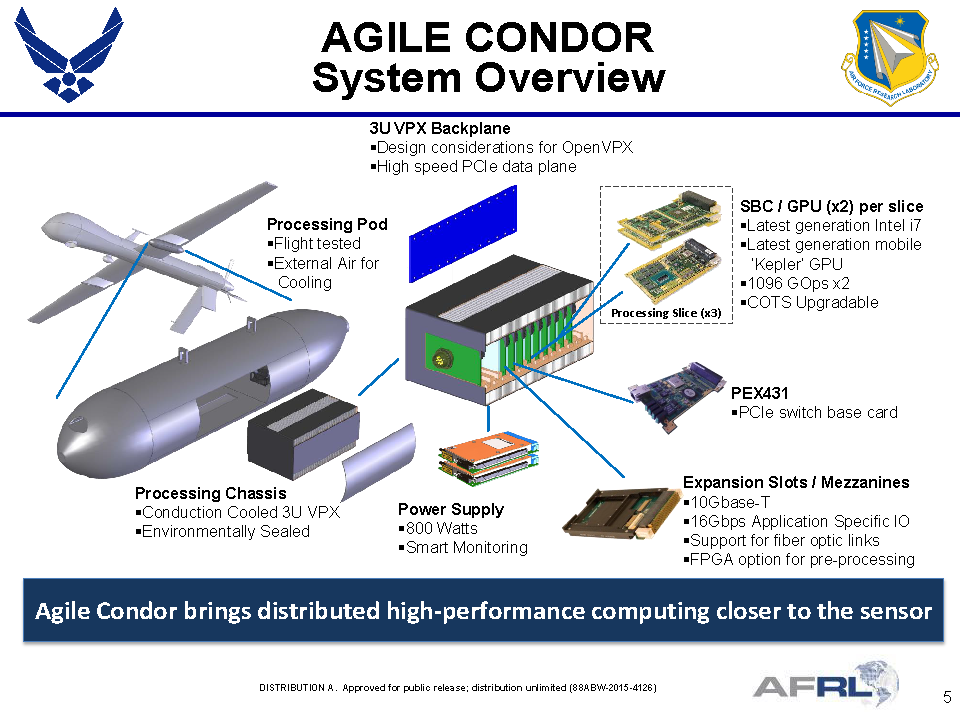
Reaper Drones to Master AI with Agile Condor Super Computing Pod - Defense Update:: General Atomics Aeronautical Systems, Inc. has been awarded a contract from the U.S. Air Force (USAF) to demonstrate the Air Force Research Lab’s “Agile Condor” capability using a company-owned MQ-9 Remotely Piloted Aircraft (RPA). The testing will determine the optimum artificial intelligence and machine learning methodologies to find, identify and track select targets. Agile Condor also has the potential to dramatically reduce satellite bandwidth requirements as a result of its ability to automatically identify, classify, and nominate targets of interest. - Defense Update:

Agile Condor HPEC Pod for Air Force | SRC, Inc.

Agile Condor® HPEC Pod for Air Force

The Agile Condor technology is capable of being flown on remotely piloted aircraft in a pod-based enclosure and enables on-board, high-performance embedded computing to derive real-time, actionable intelligence
SRC has been focused on solving myriad problems that exist around the data analysis requirements of intelligence, surveillance and reconnaissance (ISR) missions. In an effort to bring big data analysis closer to the sensor, SRC has developed the Agile Condor® high performance embedded computing architecture for the Air Force Research Lab (AFRL) in Rome, NY. The Agile Condor pod system is a scalable, low cost, size, weight and power (low-CSWaP) hardware architecture that enables high-performance embedded computing (HPEC) on-board remotely piloted aircraft (RPA).


From the 2015 IEEE High Performance and Embedded Computing Conference

HPEC is the largest computing conference in New England and is the premier conference in the world on the convergence of High Performance and Embedded Computing. 


18_Paper52AgileCondor-HPEC15-v4.pdf


18_Paper52AgileCondor-HPEC15-v4.pdf