Wednesday, January 6, 2016

Purden/Delphi Patent solves automotive radar behind bumper mount problem

United States Patent: 9231310

Radar sensor antenna with anti-reflection element


Abstract
An antenna for a radar sensor includes an emitter element, a receiver element, and an anti-reflection element. The emitter element is configured to direct the emitted signal along a boresight that intersects a fascia. The receiver element is configured to detect a reflected signal reflected by an object located beyond the fascia. The anti-reflection element is configured to reduce reflection by the antenna of an early-reflection portion reflected by the fascia.


Inventors:
Purden; George J. (Westlake Village, CA), Shi; Shawn (Thousand Oaks, CA)
Applicant:
Name City State Country Type
DELPHI TECHNOLOGIES, INC.
Troy

MI

US

Assignee:
Delphi Technologies, Inc.
(Troy, MI)
Family ID:
1000001566424
Appl. No.:
14/035,101
Filed:
September 24, 2013


This disclosure generally relates to an antenna for a radar sensor, and more particularly relates to equipping the antenna with an anti-reflection element to reduce reflection by the antenna of early-reflections caused by a fascia or other close object.


BACKGROUND OF INVENTION
It is known to place a radar sensor behind a fascia of a bumper of a vehicle for detecting objects proximate to (i.e. in front of or behind) the vehicle. As used herein, the fascia is a decorative cover placed over the impact absorbing portion of a modern bumper assembly. The fascia is generally for making the vehicle more attractive. Such a fascia is typically formed of a polymeric compound so that an emitted signal output by the radar sensor can propagate through the fascia toward an object proximate to the vehicle, and a reflected signal reflected by that object can propagate back through the fascia to be detected by the radar sensor. The configuration (e.g. material(s), thickness, orientation) of the fascia is typically selected to minimize interference with the electromagnetic signals propagating through the fascia. However, some reflection of the emitted signal by the fascia may be unavoidable for a number or reasons. This form of signal reflection is sometimes characterized as an early reflection by the fascia of the emitted signal output by the radar sensor. This early reflection may reflect back and forth between the antenna and the fascia, and possibly interfere with the detection of the reflected signal reflected by an object on the other side of the fascia. It has been proposed to place or apply electromagnetic energy absorbing material proximate to the
antenna at the locations that don't interfere with transmitting or receiving electromagnetic signals, but do help to absorb this early reflection. However, adding such absorbing material adds undesirable
cost to the radar sensor.

Reference/Background:


  • Marhefka, Ronald J.; Baertlein, B.A.; Rao, M.; Prakah-Asante, K., "Modeling the performance of automotive bumper mounted antennas," in Antennas and Propagation Society International Symposium, 2002. IEEE, vol. 3, no., pp. 316-319 vol. 3, 2002.
    Abstract: In order to improve automobile driver safety, manufacturers are exploring a variety of sensing options. A collision avoidance radar is a possible device that provides an all-weather, day-night sensing  capability. Systems of various complexities are possible, but they all require an effective antenna system. This paper explores the effects of mounting a small array behind an automobile bumper fascia. This is similar to the standard radome problem. However, the system designer has little input on the make up of the bumper fascia, in terms of  thickness, paint, and relative position of antenna and material. Material properties for this study are determined by transmission line measurements for samples of the plastic fascia with and without several different paints. Gain calculations for a patch array in various combinations of bumper configurations are found. The analysis is performed using uniform geometrical theory of diffraction (UTD) techniques. Validation is provided by measurements made in the OSU-ESL compact range
  • Remcom_EMSimulation_Automotive_Radar_inVehicle_Bumper.pdf 
  •  

FCC Broadband Report finds most ISP's meet higher advertised performance, DSL not so much

Measuring Fixed Broadband Report - 2015 | Federal Communications Commission

FCC releases fifth 'measuring broadband America' report - FierceTelecom
Nationwide test of fixed broadband services shows significant increase in broadband speeds offered to consumers
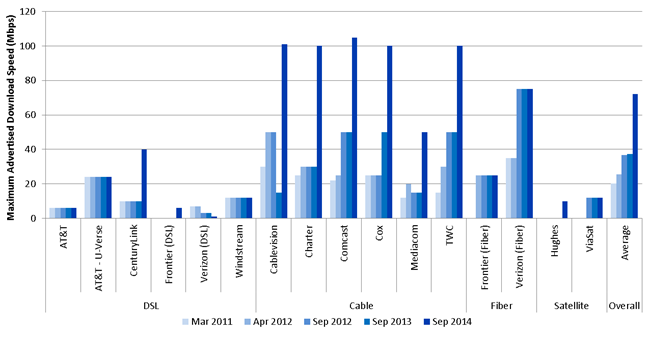
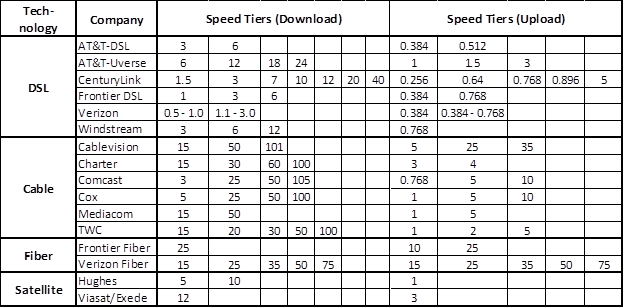
WASHINGTON, December 30, 2015 – The Federal Communications Commission today released the results of its ongoing nationwide performance study of consumers' fixed broadband Internet access service in its fifth "Measuring Broadband America" report. The report furthers the Commission's efforts to provide greater transparency about network performance to help consumers make more informed choices about broadband services. This year's report shows that broadband speed offerings to the average consumer continue to increase at a rapid pace, and broadband service providers generally are delivering actual speeds that meet or exceed advertised speeds. However, results are not uniform across technologies. The report finds a growing disparity in advertised download speeds between many DSL-based broadband services and most cable- and fiber-based broadband services.
This year's report highlights the following findings:
  • Significant growth in advertised broadband speeds available to consumers, though the results are not uniform across technologies. Averaged across all participating ISPs, maximum advertised speeds increased from 37.2 Mbps in September 2013 to 72 Mbps in September 2014 – an increase of 94 percent. 
    • Largely spurred by the deployment of enabling technologies such as DOCSIS 3, the maximum advertised download speeds offered by ISPs using cable systems increased from 12-20 Mbps in March 2011 to 50-105 Mbps in September 2014. 
    • However, popular maximum DSL speed offerings have not kept up with that growth. While average DSL consumer speeds have increased, popular maximum DSL speed offerings have stayed largely stagnant since 2011, with most DSL providers offering maximum download rates of 12 Mbps or less.
  • Actual speeds experienced by most ISPs' subscribers are close to or exceed advertised speeds. 
    • All ISPs using cable, fiber or satellite technologies advertise speeds for services that on average are close to or below the actual speeds experienced by their subscribers. 
    • However, some DSL providers continue to advertise speeds that on average exceed actual speeds.
  • Consumers with access to faster services continue to migrate to higher service tiers.
    • Participating panelists who in September 2013 subscribed to service tiers with advertised speeds between 15 and 30 Mbps – offered mostly by cable and fiber services – migrated at high rates within the following year to a service tier with a higher advertised download speed. 
    • In contrast, among panelists subscribed in September 2013 to service tiers with advertised download speeds of less than 15 Mbps – offered mostly by DSL services – only a few percent migrated within the following year to a service tier with a higher download speed.
  • Latency and packet loss vary by technologies. 
    • Consumers generally experienced low latency – the time it takes for a data packet to travel from one point to another in a network – on DSL, cable and fiber systems. 
    • Higher latency in satellite services may affect the perceived quality of highly interactive applications such as VoIP calls, video chat and multiplayer games. 
    • Consumers generally experienced low packet loss – the percentage of packets that are sent by the source but not received by the destination – on cable, satellite and fiber systems. 
    • Moderate packet loss experienced by a few DSL providers may affect the perceived quality of video chat, multiplayer games and video streaming.

 FCC Broadband Report Ranks HughesNet® Gen4 Internet Service Highest in Meeting Advertised... -- GERMANTOWN, Md., Jan. 6, 2016 /PRNewswire/ --

GERMANTOWN, Md., Jan. 6, 2016 /PRNewswire/ -- HughesNet® Gen4 satellite broadband service ranked first among all major Internet service providers for delivering on advertised performance promises in the Federal Communications Commission's (FCC) fifth annual report on consumer broadband services, "Measuring Broadband America – 2015," issued on December 30, 2015.
HughesNet is America's #1 satellite broadband service with more than 1 million subscribers, and is delivered by Hughes Network Systems, LLC (Hughes), the world's leading provider of broadband satellite solutions and services.

Monday, January 4, 2016

Federal Healthcare IT aims at a brave new world

The Federal Vision For Healthcare IT: A Dystopian Paradise | TechCrunch
In the realm of HIT, the ONC’s Federal Health IT Strategic Plan (Strategic Plan), in combination with related regulations and market forces, provides a useful guide to where the federal government hopes to see HIT move — and potential winners and losers. Taking into account recent technology and market trends, the government is actively supporting initiatives that could, and in some cases almost certainly will, lead to:
  • Increased use of in-home, wearable and portable devices that monitor your activities and health 24 hours a day and send that information to your caregiver (or, potentially, your insurer and employer). As the Strategic Plan says:
    “Existing and emerging technologies provide a path to make information and resources for health and health care management universal, integrated, equitable, accessible to all, and personally relevant. …[O]nly one in eight Americans track a health metric like blood pressure or weight using some form of electronic technology. Federal agencies seek to expand the ability of individuals to contribute electronic health information that is personally relevant and usable to their care providers so that both can use it effectively in health planning.”
  • A Learning Health System (LHS) that will take the knowledge gained from millions of patients, their genetics and their every health service, applying it to individual patients’ specific conditions. The idea of the LHS has arisen from several sources, but particularly from the Institute of Medicine’s Roundtable on Value & Science-Driven Health Care (IOM Roundtable) and the Learning Health Community (LHC).
  • Cutting-edge research finding unexpected causes and treatments for numerous diseases, without any test subjects, using nothing but data already on hand. If successfully developed and implemented, the LHS could collect data from every major provider of healthcare around the world, as well as every significant clinical research study, then analyze that data based on a particular patient’s demographics, genetics, history, diagnoses and symptoms and provide to the physician the most relevant available treatment options listed by likelihood of success.
  • Patients directly accessing, controlling and even correcting their medical records, no matter who the provider. This trend will only be pushed further by new standards for the exchange of healthcare data and development of apps and devices in which individuals will be providing, and accessing, their records. Data stored in the cloud by an app developer, and automatically integrated into an EHR, can easily be integrated into any other EHR. Just as a website can be accessed by a number of browsers, numerous market players may enter with products that can access any EHR, organize the data in it in various ways and increase the utility of the data while decreasing the cost of access.
  • A Faustian Bargain, faced by each individual or society as a whole, in which one must choose between personal privacy and the full benefits of available healthcare services. Perhaps the largest potential downside to a boom in HIT relates to our sense of privacy and the security of information shared. One could, of course, opt-out of sharing personal information, just as one may refuse to click “I agree” on end-user license agreements, refuse to carry a cell phone and stay off the Internet. For most people, however, permitting sharing of health information may become automatic, particularly when the potential price of opting out is one’s health.

AGI STK gives DIY UAV flyers tools

Drone Post Flight & Realtime Plugin for STK - YouTube
Plugin for flight reconstruction of any APM based drone flight controller. Import log file, recreate camera views, video overlays as well as Realtime mode for monitoring your drone flight, commanding the drone, and sensor/camera visualization.


Import flight log files from any APM/Pixhawk driven drone as well as captured video to produce a reconstructed flight all within a web browser!


APM:Copter | Multirotor UAV
This is the full-featured, open-source multicopter UAV controller that won the Sparkfun 2013 and 2014 Autonomous Vehicle Competition (dominating with the top five spots). A team of developers from around the globe are constantly improving and refining the performance and capabilities of Copter .
Copter is capable of the full range of flight requirements from fast paced FPV racing to smooth aerial photography to fully autonomous complex missions which can be programmed through one of 4 elegant and well-developed software ground stations. The entire package is designed to be safe, feature rich, open-ended for custom applications and increasingly easy to use even for novice users.


Related/Background:

Saturday, January 2, 2016

OPERA Radar shows flock awakened by Dutch Midnight Fireworks

Radar images from The Netherlands showing birds scattering when
fireworks are set off at midnight during 2007/8 New Year’s Eve.
KEY: green = 101; yellow = 103; red = 106 birds
(Credit: the Institute for Biodiversity and Ecosystem
Dynamics (IBED) at the University of Amsterdam / doi:10.1093/beheco/arr102)
Birds Flee En Masse From New Year's Eve Fireworks - Forbes
As you can see, almost no birds were in flight immediately before before midnight on New Year’s Eve. But only a few minutes after midnight, when fireworks were being lit in inhabited areas all over the country, massive movements — one could say “explosive” movements — of wild birds were detected. The areas with the greatest radar reflectivity (indicating the greatest density of flying birds) were seen over lakes, wetlands, and river floodplains (blue lines) — many of which are designated Natura 2000 sites, which are protected as breeding and resting sites for rare and threatened species.

Source:
Judy Shamoun-Baranes, Adriaan M. Dokter, Hans van Gasteren, E. Emiel van Loon, Hidde Leijnse, and Willem Bouten (2011). Birds flee en mass from New Year’s Eve fireworks, Behavioral Ecology, 22:1173–1177 doi:10.1093/beheco/arr102

 This study quantifies the temporal and spatial scale of immediate response of birds to fireworks; more work is clearly needed to assess the longer term consequences at the individual and population levels (e.g., Gill and Sutherland 2000; Wingfield 2003; Béchet et al. 2004; Wikelski and Cooke 2006), especially in and around areas designated for nature conservation, such as Natura 2000 sites (Anonymous 2000). The weather radar used in this study is part of an operational weather radar network (OPERA, Operational Programme for the Exchange of weather RAdar information) (Dokter et al. 2011) and as such can be a powerful tool for monitoring large movements (e.g., due to disturbance or migratory flights) across political boundaries and on a continental scale (Gauthreaux and Belser 2003; Shamoun-Baranes et al. 2008; Dokter et al. 2011). Although radar enables us to quantify the movements of birds in flight and at night, we can expect that other wildlife, not measured by the radar are also affected. Biotelemetry and field endocrinology can help further improve our understanding of individual behavioral and physiological response and the energetic cost of such disturbances in a broad range of animals (e.g., Cooke et al. 2004; Ropert-Coudert and Wilson 2005; Walker et al. 2005; Bisson et al. 2009), and an integration of techniques to study responses at different scales, at the individual and population level, could be even more promising (Robinson et al. 2010).

Related/Background:

Thursday, December 31, 2015

Prostate Cancer News - 2016-01-01


Prostate Cancer News - 2016-01-01


General Case Management


Choices you Make


Screening and Diagnosis


Biopsies, Genomics and Pathology


Tests


Imaging


Treatment

Active Surveillance


Surgery


Radiation


Hormone


Chemo


New Techniques


Side Effects


Advanced/Recurrence


GA-ASI ends Predator-A RQ-1 UAV production with 2 to Italy

GA-ASI Delivers Final Two RQ-1 Predators to Italian Air Force
Italy receives Predator-A drones
The Italian Air Force has taken delivery of two Predator-A drones from General Atomics Aeronautical Systems Inc., the last two Predator-A systems being produced.
The remotely piloted aircraft will perform intelligence, surveillance and reconnaissance missions.
"With the delivery of these aircraft, GA-ASI completes over two decades of delivering Predator A capabilities to the United States and allied countries," said Frank W. Pace, president, Aircraft Systems, GA-ASI. "Amassing over 2.1 million cumulative flight hours and featuring the highest mission capable rate of any aircraft in the Air Force's inventory, Predators will continue to keep warfighters safe by equipping them with unparalleled situational awareness for many years to come."

Italian delivery marks end of General Atomics RQ-1 production
General Atomics says Italy now operates 15 of its unmanned aircraft, but would not reveal how many of each type at the customer’s request. It took delivery of its first RQ-1 in 2004, and has also procured six MQ-9s that were recently approved by the US government to carry weapons.
That suggests a total of nine Italian RQ-1s, which are used for intelligence gathering. The aircraft are particularly active over the Mediterranean Sea and in support of NATO operations.
The manufacturer says the last RQ-1 exited the production line in Poway, California, in September or October. Testing is completed at another site in the Palmdale region.

 Related/Background:

Wednesday, December 30, 2015

A key AHRQ Health Care Metric - HAC rates down - but not so much lately and with some surprising laggards

AHRQ Data Show HAC Rate Continues To Decline in 2013 |
Agency for Healthcare Research & Quality
Hospital-Acquired Condition (HAC) Reduction Program - Centers for Medicare & Medicaid Services
 
HHS: EHRs, Financial Incentives Have Helped Increase Patient Safety As HACS Decline 17 Percent | Healthcare Informatics Magazine | Health IT | Information Technology
The widespread adoption of electronic health records (EHRs) has helped reduce hospital-acquired conditions by 17 percent over the past four years, resulting in 87,000 fewer patient deaths in 2014 alone, according to data collected by the Agency for Healthcare Research and Quality (AHRQ).
AHRQ, which operates under the U.S. Department of Health and Human Services, notes that hospitals have made “substantial progress in improving safety” and credits several likely contributing causes, including improved use of EHRs and financial incentives.
The AHRQ report states that hospital patients experienced 2.1 million fewer hospital-acquired conditions (HACs) from 2010 to 2014, which also saved the healthcare system approximately $19.8 billion in costs.
However, AHRQ data also indicates that after three years of declines in the number of avoidable HACs, that rate hit a plateau in 2014. Data shows that there were 145 HACS per 1,000 discharges in 2010 and that figure dropped to 121 per 1,000 discharges in 2013 and has held steady in 2014.


Hospital-acquired condition rates down but not as significant as first appears - FierceHealthcare
Efforts to reduce hospital-acquired conditions (HACs) have led to 87,000 fewer patient deaths and nearly $20 billion in healthcare cost savings over a four-year period, according to a new report released by the Department of Health and Human Services. But the findings may not be as significant as they seem.
Although federal officials lauded the findings from the Agency for Healthcare Research and Quality (AHRQ), patient safety experts interviewed by Kaiser Health News said that while hospitals have made progress, the preliminary 2014 data isn't as impressive as it may initially appear. Indeed the findings were similar to an AHRQ report released last month that showed hospital complications were 17 percent lower in 2013 than 2010. But the 17 percent decline is the same statistic cited in the latest report that includes 2014 data.
"We are still trying to understand all the factors involved, but I think the improvements we saw from 2010 to 2013 were very likely the low-hanging fruit, the easy problems to solve," Richard Kronick, Ph.D., director of the federal AHRQ, told KHN.

Nearly 800 hospitals receive penalties for poor hospital-acquired condition scores - FierceHealthcare
The Centers for Medicare & Medicaid Services will levy a 1 percent reimbursement penalty against nearly 800 hospitals due to poor performance on hospital-acquired conditions (HACs), the agency announced.
Of the 3,308 U.S. hospitals subject to Medicare's HAC program this year, 758 received the penalty compared to 724 last year. Only about half of the penalized providers were subject to the same penalty last year. The facilities in question stand to lose about $364 million in reimbursements.
However, the agency said hospital scores improved for central-line infections, but dropped for catheter-related urinary tract infections. CMS has also added new quality information to its Hospital Compare site, adding data on group practices and accountable care organizations, the agency said, as well as its first set of performance measures for individual practitioners on patient safety, cardiovascular care and patient safety.

Fiscal Year (FY) 2016 Results for the CMS Hospital-Acquired Conditions (HAC) Reduction Program
Public Reporting
On December 10, 2015, CMS made the following HAC Reduction Program information publicly available for each eligible hospital:
  • PSI 90 Composite measure score
  • CLABSI, CAUTI, and SSI measure scores
  • Domain 1 and Domain 2 scores
  • Total HAC Score
The FY2016 HAC Reduction Program scores for hospitals can be found on the Hospital Compare Website by following this link:
https://www.medicare.gov/hospitalcompare/HAC-reduction-program.html
The list of hospitals subject to the payment adjustments are posted on the following CMS.gov website under this link:
https://www.cms.gov/Medicare/Medicare-Fee-for-Service-Payment/AcuteInpatientPPS/HAC-Reduction-Program.html

Six local hospitals fined by Medicare for preventable infections | SanDiegoUnionTribune.com
Too many patients still acquire infections and other potentially deadly yet avoidable complications, the government’s latest review of quality-control efforts at hospitals across the country shows.
The problem plagues hospitals large and small, including prestigious medical centers with a reputation for top-flight care. For example, Scripps Green Hospital in La Jolla and UC San Diego Medical Center’s campuses in Hillcrest and La Jolla have infection scores that put them in the worst 5 percent of hospitals nationwide.
Infections and other hospital-acquired conditions are hardly a new challenge. But they are getting greater attention as part of health reforms rolled out with the Affordable Care Act, also known as Obamacare.
They are also part of a push by regulators to compel hospitals to scrutinize every aspect of their operations, including the most mundane tasks, so patients recover faster, get discharged promptly and receive proper follow-up treatment so they do not have to be readmitted.
Health officials and an assortment of independent ratings groups look at whether doctors and nurses are following nationally recommended standards of treatment. They assess whether hospitals are doing enough training and enforcement to minimize medication errors, preventable falls, bedsores, surgical mix-ups and the like. They also evaluate the continuum of care between a hospital and its affiliated physician groups.

Hospital-Acquired Conditions - Centers for Medicare & Medicaid Services
These 14 categories of HACs listed below include the new HACs from the IPPS FY 2013 Final Rule which are Surgical Site Infection Following Cardiac Implantable Electronic Device (CIED) and Iatrogenic Pneumothorax with Venous Catheterization.  For FY 2014and FY 2015, there are no additional HACs added:
  1. Foreign Object Retained After Surgery
  2. Air Embolism
  3. Blood Incompatibility
  4. Stage III and IV Pressure Ulcers
  5. Falls and Trauma: Fractures, Dislocations, Intracranial Injuries, Crushing Injuries, Burn, and Other Injuries
  6. Manifestations of Poor Glycemic Control: Diabetic Ketoacidosis, Nonketotic Hyperosmolar Coma, Hypoglycemic Coma, Secondary Diabetes with Ketoacidosis, Secondary Diabetes with Hyperosmolarity, 
  7. Catheter-Associated Urinary Tract Infection (UTI)
  8. Vascular Catheter-Associated Infection
  9. Surgical Site Infection, Mediastinitis, Following Coronary Artery Bypass Graft (CABG):
  10. Surgical Site Infection Following Bariatric Surgery for Obesity: Laparoscopic Gastric Bypass, Gastroenterostomy, Laparoscopic Gastric Restrictive Surgery
  11. Surgical Site Infection Following Certain Orthopedic Procedures: Spine, Neck, Shoulder, Elbow
  12. Surgical Site Infection Following Cardiac Implantable Electronic Device (CIED)
  13. Deep Vein Thrombosis (DVT)/Pulmonary Embolism (PE) Following Certain Orthopedic Procedures: Total Knee Replacement, Hip Replacement
  14. Iatrogenic Pneumothorax with Venous Catheterization

Related/Background:

Hot off the NASA Presses - a 3-D Printed Rocket Engine

Engineers Zach Jones left, and Chris Protz examine the
first, full-scale 3-D printed copper engine part in
the additive manufacturing laboratory at Marshall.
Image Credit: NASA/MSFC/Emmett Given
The Marshall Star | NASA
Engineers prepare a 3-D printed breadboard engine made up of
75 percent of the parts needed to build a rocket engine for a
test at NASA’s Marshall Space Flight Center in Huntsville,
Alabama.Credits: NASA/MSFC/Emmett Given

Only a handful of copper rocket parts have been made with additive manufacturing, so NASA is breaking new technological ground by 3-D printing a rocket component that must withstand both extreme hot and cold temperatures and has complex cooling channels built on the outside of an inner wall that is as thin as a pencil mark. To increase U.S. industrial competitiveness, data will be made available to American manufacturers in NASA’s Materials and Processing Information System (MAPTIS) managed by Marshall.
“Our goal is to build rocket engine parts up to 10 times faster and reduce cost by more than 50 percent,” said Chris Protz, the Marshall propulsion engineer leading the project. “We are not trying to just make and test one part. We are developing a repeatable process that industry can adopt to manufacture engine parts with advanced designs. The ultimate goal is to make building rocket engines more affordable for everyone.”
The next step in this project is for Marshall engineers to ship the copper liner to NASA’s Langley Research Center, where an electron-beam, freedom fabrication facility will direct-deposit a nickel super-alloy structural jacket onto the outside of the copper liner. Later this summer, the engine component will be hot-fire tested at Marshall to determine how the engine performs under extreme temperatures and pressures simulating the conditions inside the engine as it burns propellant during a rocket flight.

NASA Team Moves Closer to Building a 3-D Printed Rocket Engine | NASA

A NASA team moved a step closer to building a completely 3-D printed, high-performance rocket engine by manufacturing complex engine parts and test firing them together with cryogenic liquid hydrogen and oxygen to produce 20,000 pounds of thrust.
Additive manufacturing, or 3-D printing, is a key technology for enhancing space vehicle designs and manufacturing and enabling more affordable exploration missions. The technology has the potential to influence spacecraft built for leaving Earth and spaceships and landers for visiting other destinations. Future plans include performing engine tests with liquid oxygen and methane--key propellants for Martian landers since methane and oxygen production might be possible on the Red Planet.
“We manufactured and then tested about 75 percent of the parts needed to build a 3-D printed rocket engine,” said Elizabeth Robertson, the project manager for the additively manufactured demonstrator engine at NASA’s Marshall Space Flight Center in Huntsville, Alabama. “By testing the turbopumps, injectors and valves together, we’ve shown that it would be possible to build a 3-D printed engine for multiple purposes such as landers, in-space propulsion or rocket engine upper stages.”


Models | 3D Resources (Beta)

Sunday, December 27, 2015

San Diego Winners in 2016 Spending bill

The mobile landing platform Lewis B. Puller (T-MLP-3/T-AFSB-1)
successfully completed launch and float-off at the General
Dynamics National Steel and Shipbuilding Co. (NASSCO)
shipyard on Nov. 6, 2014. US Navy Photo
USAF MQ-9 Reaper
Obama administration directs $250 million
toward fighting wildfires - LA Times
SDMAC Economic Impact Study
San Diego, CA - Today the San Diego Military Advisory Council (SDMAC) unveiled its 7th Annual SDMAC Military Economic Impact Study (SDMAC MEIS) at a press conference and luncheon at the Admiral Kidd Club located on Naval Base Point Loma. The annual study, commissioned by SDMAC and produced by the Fermanian Business and Economic Institute at Point Loma Nazarene University, solidifies the significant and tremendous impact the defense and military communities bring to the entire San Diego region - and the continuous threats of political gridlock and imposed budget caps. 

$25B in Defense Funds Expected in 2016: Report | NBC 7 San Diego

Highlights of the Department of the Navy FY 2016 Budget book.pdf

Spending bill bolsters San Diego | SanDiegoUnionTribune.com
  • Local Military Impact
    • School systems will get a little more cash for teaching military dependents. 
    • Service members are getting a 1.3 percent raise.
    • Military housing spending is going up.
  • Local Contractors
  • Local Government Projects
    • wildfire fighting and prevention spending.
    • Department of Transportation  Highway Trust Fund project financing for local projects eligible for those funds such as 
      • the Metropolitan Transit System’s rapid bus system, 
      • the San Diego Trolley (for improvements to platforms and new shelters), and 
      • new carpool lanes on I-805.

Wednesday, December 23, 2015

FAA tries to deal with proliferation of micro-UAV's


No Drone Zone

UAV Pilot Cited For Flying Aircraft Near Washington Monument | Aero-News Network
The Associated Press reports that in a news release, Park Police say that three people were flying a Wondertech Zenith UAV on the grounds of the monument last Thursday. Police cited 24-year-old William Stokes Jr. after ordering him to land the aircraft, which was confiscated.
The entire D.C. area is part of a "No Drone Zone" established by the FAA earlier this year. A "No Fly Zone" was imposed over the Nation's Capitol following the September 11, 2001 terrorist attacks. The "No Drone Zone" includes everything in a 15 mile radius of Ronald Reagan National Airport in Virginia.
Officials say that the most recent incident is the 10th illegal flight of a UAV in the national park in the Washington area this year.
 
So Your Neighbor Got a Drone for Christmas - Scientific American
Today thousands of people and businesses across the country fly drones, and that number is set to explode: The Federal Aviation Administration (FAA) anticipates that this holiday season people will purchase as many as one million drones. In an effort to control this flood of flying machines the FAA announced this week that it would require recreational drone users to register their aircraft. But a big question with major implications for the drone industry is far from being resolved: Who owns the airspace above private property? As Stuart Banner, a University of California, Los Angeles, law professor, puts it, “Drones are forcing people to think about this issue for the first time since airplanes were invented a century ago.”

FAA releases web-based system for small UAS registration - Military Embedded Systems
WASHINGTON. Owners of small unmanned aircraft (UAS) can use a new streamlined, web-based process to register their aircraft. U.S. Department Transportation’s Federal Aviation Administration (FAA) officials announced the new ruling during the holiday season.

“Make no mistake: unmanned aircraft enthusiast are , and with that title comes a great deal of responsibility,” says U.S. Transportation Secretary Anthony Foxx. “Registration gives us an opportunity to work with these users to operate their unmanned aircraft safely. I’m excited to welcome these new aviators into the culture of safety and responsibility that defines American .”
To register online, visit: www.faa.gov/uas/registration.

FAA Announces Rules for Aircraft Registration Process - FlyingGiants

  • Registration is required for: small unmanned aircraft (UAS) weighing more than 0.55 pounds (250 grams) and less than 55 pounds (approx. 25 kilograms).
  • Under this rule, any owner of a small UAS who has previously operated an unmanned aircraft exclusively as a model aircraft prior to December 21, 2015, must register no later than February 19, 2016.
  • Owners of any other UAS purchased for use as a model aircraft after December 21, 2015 must register before the first flight outdoors.
  • Owners may register through a web-based system at www.faa.gov/uas/registration.
  • Registrants will need to provide their name, home address and e-mail address. Upon completion of the registration process, the web application will generate a Certificate of Aircraft Registration/Proof of Ownership that will include a unique identification number for the UAS owner, which must be marked on the aircraft.
  • Owners using the model aircraft for hobby or recreation will only have to register once and may use the same identification number for all of their model UAS. The registration is valid for three years.
  • The normal registration fee is $5, but in an effort to encourage as many people as possible to register quickly, the FAA is waiving this fee for the first 30 days (from Dec. 21, 2015 to Jan 20, 2016).
FAA Issues Fact Sheet On State And Local UAS Laws | Aero-News Network
The FAA has issued a new fact sheet on state and local regulation of unmanned aircraft systems (UAS) which provides information for states and municipalities considering laws or regulations addressing UAS use. The document outlines FAA's safety reasons for federal oversight of aviation and airspace, and explains federal responsibility in this area.

FAA Announces Drone Registration Rules; Benefits Remain Unclear - Forbes
In a much-anticipated announcement this morning, the FAA unveiled its drone registration requirements in anticipation of what many experts predict will be a brisk drone-buying holiday season. As I’ve written about previously, the FAA – spurred by what it terms a dramatic increase in pilot reports of drones too close to manned aircraft – determined that registration was necessary to “increase accountability and education” of drone operators. (The data used by the FAA has been debunked by a number of people, including most recently the Academy of Model Aeronautics.)

Parsing The New UAV Registration Rule | Aero-News Network
The new UAV registration rule is "more activity than action," according to at least one attorney-turned-consultant who has been through the 211 pages of the rule.
An article posted to the blog JDA Journal by Consultant Sandy Murdock, who lists "Former FAA Chief Counsel and Acting FAA Deputy Administrator" as part of his vitae, asserts that the process of registration will not enhance safety in the national air space.
By now, we're all aware that any UAV that weighs more than 250 grams must be registered with the FAA. According to the blog, the Interim Final Rule (IFR) is 211 pages of single-spaced small text ... and about 180 of those are an introduction and explanation of the rule. Overall, less than 5 percent of the verbiage in the document is the actual rule.

Aviation Today :: Drone Registration for the Non-Hobbyist
The Dec. 16 Interim Final Rule most immediately applies to drone hobbyists operating under the “model aircraft” definition—aircraft used for non-commercial purposes and within visual line of sight. These applicants have been provided an online alternative to the paper-based aircraft registration system by way of a new 14 CFR Part 48. Every three years, they also will pay a $5 registration, which covers all of their drones.

FAA Finally Admits Names And Home Addresses In Drone Registry Will Be Publicly Available - Forbes
The FAA finally confirmed this afternoon that model aircraft registrants’ names and home addresses will be public. In an email message, the FAA stated: “Until the drone registry system is modified, the FAA will not release names and address. When the drone registry system is modified to permit public searches of registration numbers, names and addresses will be revealed through those searches.”

Monday, December 21, 2015

RAND - Funding Ship Maintenance a Big Problem

San Diego Ship Repair to Expand Capabilities
Navy Surface Fleet Faces Rough Waters Trying to Maintain Ships
The Navy in the past decade has found itself in a downward spiral of maintenance problems. It has subjected the fleet to high operational tempos that increased wear and tear and has cut back routine practices that help identify onboard repair needs, such as ship inspections and assessments.

The service is trying to revamp its maintenance policies to include more inspections, new technology and a shift in culture. Progress is occurring, but changes will take a while to stick, and the service will likely have to deal with budget cuts that make it more difficult to maintain its ships, Navy and industry officials said.

Water is drained from a dry dock at U.S. Naval Ship Repair
Facility and Japan Regional Maintenance Center (SRF JRMC)
Yokosuka preparing the Ticonderoga-class guided-missile
cruiser USS Shiloh (CG 67) for a scheduled maintenance
availability in July 2015. US Navy photo.
Navy Refining Surface Ship Master Plan to Balance Shipyard, Operational Needs - USNI News
SAN DIEGO – The Navy’s maintenance and operational communities have completed the first iterations of a surface ship master plan for maintenance and modernization work, in the hopes of balancing out peaks and valleys in shipyard workload without impacting operational needs.
The effort began after Fiscal Year 2013, when the Navy’s regional maintenance centers were performing as much as 40 percent more work than predicted, Rear Adm. Bill Galinis, deputy commander of surface warfare at Naval Sea Systems Command (NAVSEA) and commander of Navy Regional Maintenance Center, said at the American Society of Naval Engineers’ annual Fleet Maintenance and Modernization Symposium. In some cases, the estimates did not accurately predict how much repair work was needed, and in some cases the predictions only included mid-life work on older ships but forgot to include post-shakedown availabilities for brand new ships.


Assessment of Surface Ship Maintenance Requirements | RAND

Key Findings

Since the Late 1990s, Expenditures per Ship Are Growing at an Increasing Rate

  • This fact runs parallel to the legislative environment, which impact available resources. Annual shortfalls now amount to $8 billion between requested budget and legislatively authorized possible if legislation does not change.
  • Pressure on maintenance budgets is expected to grow as the effects of sequestration are felt, with no expected diminishment in the demand for naval forces.
  • Even absent sequestration, continued growth in per-ship maintenance cost is likely unsustainable, at least at the rate seen in the last 15 years. At the rate seen, maintenance would either become a larger component of the operations and management budget or come at the expense of new construction or modernization or require deferral.

A Study of the DDG-51 Class Shows the Mismatch Between Navy's Claims for Maintenance and What Is Spent

  • A comparison between the cumulative maintenance levels for the DDG-51 and the levels specified in the Navy's technical foundation papers showed that the Navy is not in general funding to the level as stated in the technical foundation papers.
  • This casts doubt on the validity of the technical foundation papers' requirements and the Navy's commitment to carrying out the maintenance stated in these published papers.
  • Given this, the Navy will need to consider alternatives to the technical foundation papers' process as it formulates requirements and source plans.

Deferred Maintenance of Ships Affected by Individual History of Ships

  • Ships of similar age and operating histories whose major difference is basing histories — with the attendant effects on maintenance — can show dramatic differences between the overall costs to maintain.
  • Maintenance deferrals exact an extremely high premium that drives ship cost up in ways inconsistent with the need to contain costs.
  • Any maintenance construct needs to understand and budget for the high cost of deferral or devise mitigations for cases where deferral is inevitable.

Recommendations

This report recommends actions the Navy can take to address surface ship maintenance and operations requirements in the context of fiscal constraints.

  • A maintenance strategy that prioritizes selected restricted availabilities (SRAs), which are relatively lengthy and well funded, but the time and money available for maintenance in SRAs is limited. Maintenance priorities within SRAs are assigned based on safety concerns, the predictability of failures, the consequences of failures, and the future cost of deferring maintenance.
  • If the maintenance required is relatively straightforward, and can be conducted with available personnel or can be broken down into manageable segments, then a continuous maintenance availability can provide an efficient and cost-effective alternative to an SRA.