"Because space launch is so expensive, we loaded as much as we could onto our satellites -- multiple missions, multiple payloads, " Gen William Shelton, commander of Air Force Space Command told GWU students today (1/7/2014) . "After all, we were operating in a relatively peaceful sanctuary in space."
Not today. "As I look at the next 20 years in space, we have a difficult, up-hill climb ahead of us," he said. "I equate this to the difficulty of turning the Queen Mary. You send the rudder command and the delayed response tries your patience."
To sustain space services, the United States must consider architectural alternatives for future satellite constellations. "These alternatives must balance required capability, affordability and resilience," he said. "There are many options that we're actively studying right now. The notion of disaggregation is one. And what we mean by this is moving away from the multiple payload, big satellite construct into a less complex satellite architecture with multiple components."
Distributing space payloads across multiple satellite platforms, increases U.S. resiliency. "At a minimum, it complicates our adversaries' targeting calculus," he said.
Wednesday, January 8, 2014
Shelton points future satellites to many small single purpose units for resiliency
Defense.gov News Article: Shelton Discusses Importance of Space Defense

ScanEagle, Raven UAVs and Hellfire Missiles to Iraq to help counter al-Qaida
Defense.gov News Article: DOD Speeds Delivery of Surveillance Assets to Iraq
WASHINGTON, Jan. 7, 2014 - The United States is speeding delivery of unmanned aerial vehicles Iraq purchased under the foreign military sales program to help in tracking and thwarting al-Qaida-affiliated groups, a Pentagon spokesman said today.
| Boeing Insitu ScanEagle Cutaway |
 |
| ScanEagle Launch |
Warren also reported that the original purchase included delivery of 75 AGM-114 Hellfire missiles in mid-December, with another 100 to be ready for delivery by spring.
Hellfires do more than surveillance. MQ-9 Reaper weapon of choice.

 |
Preparing AeroVironment RQ-11Raven UAV |
Tuesday, January 7, 2014
Exelis - GCA/PAR-2000 sells in eastern Europe
Exelis - GCA/PAR-2000
 The GCA/PAR-2000 is a compact Airport Surveillance Radar (ASR) /
Precision Approach Radar (PAR) System providing high performance target
detection in the airspace around an airport or air base. Simultaneous
ASR and PAR operations from the single sensor provide accurate display
of both types of radar data.
Versatile, multimode, digital color displays and full communications support all controller operations. The ASR covers 30 nautical miles (nmi) at altitudes up to 8,000 feet. The PAR coverage is up to 20 nmi with azimuth coverage of 30 degrees and elevation coverage of 8 degrees. A PAR-only version (PAR-2000) is also available. The GCA/PAR-2000 comes in fixed, transportable, and mobile (AN/MPN-25) versions.
Exelis to provide Estonia with transportable ground control approach radar
Exelis to supply transportable ground control approach radar systems to Poland - WSJ.com
The GCA/PAR-2000 is a compact Airport Surveillance Radar (ASR) /
Precision Approach Radar (PAR) System providing high performance target
detection in the airspace around an airport or air base. Simultaneous
ASR and PAR operations from the single sensor provide accurate display
of both types of radar data.Versatile, multimode, digital color displays and full communications support all controller operations. The ASR covers 30 nautical miles (nmi) at altitudes up to 8,000 feet. The PAR coverage is up to 20 nmi with azimuth coverage of 30 degrees and elevation coverage of 8 degrees. A PAR-only version (PAR-2000) is also available. The GCA/PAR-2000 comes in fixed, transportable, and mobile (AN/MPN-25) versions.
Exelis to provide Estonia with transportable ground control approach radar
Exelis to supply transportable ground control approach radar systems to Poland - WSJ.com
New Voronezh radar stations in Russia in 2014 expand SRPN(BMD) Capability

Russia activates new early warning radar systems | Russia Beyond The Headlines
 |
| The Voronezh-DM early warning radar in Kaliningrad is set to be put on combat duty in late 2014. Source: Kremlin.ru |
- Voronezh-M (77Ya6-M) works in the metre range (VHF) and was designed by RTI Mints.
- Voronezh-DM (77Ya6-DM) works in the decimeter range (UHF) and was designed by NPK NIIDAR. Has a range of 6,000 km and is capable of simultaneously tracking 500 objects.[6][7]
Two new radar stations of the missile warning system will be placed into service in Russia's Kaliningrad and Irkutsk regions this year, the Defence Ministry's press service and information department said. Work to set up radar stations will also continue in the Krasnoyarsk, Altai, Orenburg and Arctic regions, the ministry said.
The main centre of missile attack warning has four new-generation radar stations at present -
- a Voronezh-M station on duty in the Leningrad Region and a
- Voronezh-DM in the Krasnodar Territory,
- - the Voronezh-DM in the Kaliningrad Region and
- the Voronezh-M in the Irkutsk Region -
 |
| Voronezh-M radar in Irkutsk Region |
The new assembly technology allows the construction of radars from standard container-type macro-modules at the place of deployment, while the infrastructure required for this purpose is minimal. As a result, the radar deployment period has been reduced to 12-18 months, compared to 5-9 years previously, the spokesman said.
Four Voronezh-class radar stations built with the use of high factory-readiness technology are already part of the Russian missile early warning network.
 |
| Voronezh-DM early warning radar in Kaliningrad, Russia. |
A Voronezh-DM radar is on combat duty in the Krasnodar territory and a Voronezh-M radar - in the Leningrad region. The Voronezh-DM radars in the Kaliningrad and Irkutsk regions are in the testing stage of operation.
Voronezh-class radars have an operational range of 6,000 kilometers (3,728 miles). They can be quickly redeployed to a new site and require a smaller crew to operate, compared to previous generation stations.
 |
| A radar station Voronezh-DM located at Armavir covers more than 3,700 miles , including the entire Black Sea and Mediterranean. Source: ITAR-TASS |
Armavir Radar Station (Russian: Радиолокационная станция (РЛС) в Армавире) is an early warning radar station near Armavir in Krasnodar Krai, Russia. It is a key part of the Russian early warning system against missile attack and is run by the Russian Aerospace Defence Forces. There are two radars here - one faces south west and one south east. They provide radar coverage of the Middle East. The station is located on the former Baronovsky Airfield (Russian: аэродром Бароновский) 3 kilometres (1.9 mi) south west of the village of Glubokiy and 12 kilometres (7.5 mi) south west of Armavir.
Armavir radar keeps an eye on the Middle East | Russia Beyond The Headlines
Russia’s missile attack warning system (SRPN) detected the launch of two ballistic targets in the Mediterranean on Sept. 3. A radar station located at Armavir tracked the launch of two missiles that dropped into the sea.
As was subsequently reported, the launch was a joint Israeli-U.S. missile experiment. The Israeli military initially claimed to have no knowledge on any launches. Several hours later, however, the Israeli Defense Ministry admitted to the launch, which it said involved the firing and tracking of a Sparrow target missile and also consisted of “testing of the Arrow 2 antiballistic shield.”
Americans took part in the tests, the Pentagon later confirmed. “The United States Department of Defense provided technical assistance” and “the test was long planned,” Pentagon Press Secretary George Little said.
Sunday, January 5, 2014
Huge wireless network will greet 2014 Winter Olympics
Sochi 2014 Winter Olympics - Olympic Tickets, Schedules, Games, News
olympic networks

 |
| The Avaya network will be run at a primary Technical Operations Center in the coastal city of Adler, while the secondary TOC and Data Center will be at the Sochi Olympic Park. |
In Sochi, Avaya’s Wi-Fi network will be split into five virtual SSID-based networks. There will be one network for the athletes, two for media (one free, one paid), one for Olympics staff, and one for dignitaries.
Each group will have its own access password, and extra layers of password protection will be added where needed. The Wi-Fi traffic will be distributed using about 2000 802.11n access points across the Olympics Game sites; including inside the stands for the first time.
GPS Constellations used to probe Earth's mass
Earth may be heaver than thought due to invisible belt of dark matter
no picture of dark matter available ;-)
In 2009, researchers at the Institute of Advanced Studies in Princeton, N.J., theorized that observed changes in the speeds of space probes as they flew past the Earth could be explained by dark matter bound by Earth's gravity.
Can the flyby anomaly be attributed to earth-bound dark matter?
Stephen L. Adler∗ Institute for Advanced Study, Einstein Drive, Princeton, NJ 08540, USA
Now Ben Harris at the University of Texas at Arlington used orbiting satellites to see if dark matter might be affecting them. Using data on the satellites in the U.S. GPS, Russian GLONASS and
European Galileo groups, he calculated Earth's mass as "felt" by each
satellite.
GPS satellites suggest Earth is heavy with dark matter - physics-math - 02 January 2014 - New Scientist
no picture of dark matter available ;-)
In 2009, researchers at the Institute of Advanced Studies in Princeton, N.J., theorized that observed changes in the speeds of space probes as they flew past the Earth could be explained by dark matter bound by Earth's gravity.
Can the flyby anomaly be attributed to earth-bound dark matter?
Stephen L. Adler∗ Institute for Advanced Study, Einstein Drive, Princeton, NJ 08540, USA
We make preliminary estimates to assess whether the recently reported flyby anomaly can be attributed to dark matter interactions. We consider both elastic and exothermic inelastic scattering from dark matter constituents; for isotropic dark matter velocity distributions, the former decrease, while the latter increase, the final flyby velocity. The fact that the observed flyby velocity anomaly shows examples with both positive and negative signs, requires the dominance of different dark matter scattering processes along different flyby trajectories.
The magnitude of the observed anomalies requires dark matter densities many orders of magnitude greater than the galactic halo density. Such a large density could result from an accumulation cascade, in which the solar system-bound dark matter density is much higher than the galactic halo density, and the earth-bound density is much higher than the solar system-bound density. We discuss a number of strong constraints on the hypothesis of a dark matter explanation for the flyby anomaly. These require dark matter to be non-selfannihilating, with the dark matter scattering cross section on nucleons much larger, and the dark matter mass much lighter, than usually assumed.
 |
| Ben Harris |
GPS satellites suggest Earth is heavy with dark matter - physics-math - 02 January 2014 - New Scientist
Harris has yet to account for perturbations to the
satellites' orbits due to relativity, and the gravitational pull of the
sun and moon. What's more, preliminary data from NASA's Juno probe,
also presented at the AGU Fall meeting, suggests its speed was as expected
as it flew by Earth, casting doubt on the earlier anomalies.
But if Harris's explanation is correct, satellites could reveal properties of dark matter, such as whether its particles interact with each other.
Ben Harris has fifteen years of R&D experience with navigation and
telecommunication satellite systems. For the majority of that time he
worked at Applied Research Laboratories, the University of Texas at
Austin, on a project that enhanced the performance of the GPS system.
During that period he helped establish the open source project the GPS
Toolkit
(www.gpstk.org). He has focused on
how receivers can mitigate the impact of signal reflection (multipath).
He is exploring a variety of techniques, including the application of
software receivers and new antenna designs.
Earth May Have Dark Matter Halo - disinformation
Earth May Have Dark Matter Halo - disinformation
Saturday, January 4, 2014
Publish And Perish? What To Do With That Book Inside Of You | TechCrunch

Sometimes I think that book inside is like the alien in the first alien movie, struggling to get out.
The best an author can get is a traditional publisher throwing its full weight behind their book. That hasn’t changed and won’t anytime soon. But mere half-hearted support from a major publisher seems to me in many ways worse than successful crowdfunding. You do get notability, prestige, a (probably crappy) advance, a better chance at critical reviews, and handholding; but you sacrifice almost all control, for an indefinite and probably very long period.
Which is a big deal nowadays. That control gives you a lot of ways to increase your readership online. In particular, Amazon’s Kindle Direct offers a number of effective (albeit time-limited) promotional options, including making your books available for free, or making them very cheap while still claiming their 70% royalty rate. And/or you can bite the bullet and Creative-Commons-license your work for free, as I’ve done. Major publishers are, quite rationally, rarely interested in doing this; it might be good for the author in the long run, but it’s not particularly likely to be good for them.
Philippines Creates Its Own small UAVs

Although there is little information about these UAS, the PA claims that the Raptor and Knight Falcon (as they are called) UAS are capable of providing real time imagery and video feed from a distance of 3km to 7km, and has an endurance of 3 hours. According to the PA, these UAS will complements their existing Human Intelligence (HUMINT) and Signal Intelligence (SIGINT) capabilities, and can also be used in Humanitarian Assistance and Disaster Relief (HADR) operations.

Warplanes: The Philippines Creates Its Own Combat UAVs
January 3, 2014: In the Philippines the military has long been used to getting by on very tight budgets. That means developing tactics, techniques and improvised weapons and equipment to get the job done. The latest example is two micro-UAVs called Raptor (costing $3,400 each) and Knight Falcon (goes for about $6,700 each). Both of these are similar to the American Raven, which has been used in the Philippines in small quantities.
DOD Issues 25-Year Unmanned Systems Roadmap

Document: Pentagon's Unmanned Systems Roadmap | USNI News
The report to Congress is an attempt to chart how unmanned systems fit into the defense of the nation.

“The 2013 Unmanned Systems Integrated Roadmap articulates a vision and strategy for the continued development, production, test, training, operation and sustainment of unmanned systems technology across DOD,” said Dyke Weatherington, the director of the unmanned warfare and intelligence, surveillance and reconnaissance office at the Pentagon.
“This road map establishes a technological vision for the next 25 years and outlines the actions and technologies for DOD and industry to pursue to intelligently and affordably align with this vision,” he continued.
Unmanned aerial vehicles have received the most press, but unmanned underwater vehicles and ground vehicles are also providing warfighters with incredible capabilities.
Although unmanned vehicles have proved their worth in combat operations throughout the Middle East and Central Asia, current technologies must be expanded and integrated into the sinews of the defense establishment, the report says.
Pentagon Issues 25-Year Unmanned Systems Roadmap | Aviation International News
January 3, 2014, 10:20 AM
US military report predicts drone swarms, highly autonomous UAVs — RT USA
“System vulnerabilities and threats are examined, as well as risk of exposure and consequence of system compromise, to proactively establish the foundation of security disciplines as early as reasonable in the developmental life cycle,” the Roadmap notes. “Impact to the program in terms of cost, schedules, and performance is also factored into the determination of appropriate protective measures.”
Unmanned aerial systems currently constitute a major drain on the military's budget. Officials hope to ease this burden without sacrificing any firepower by shifting many of the human responsibilities to the drone itself. Taken literally, this process involves ending the execution of step-by-step commands and employing commands that the report notes may “require deviation from pre-programmed tasks.”
Top Ten: Thing That Matter That You Hardly Ever Hear About
Top Ten: Thing That Matter That You Hardly Ever Hear About
1. Anti-Terrorism Operations. You're meant not to hear about them.
2. Bureaucrats vs. the Troops. Other agencies (non DoD) are wrapping military in red tape.
3. Jointness Games. US is really getting seriously joint.
4. Media Wars. The whole world is spinning.
5. Military Pork Barrel. "how can this help me get reelected, rich, or both."
6. Resurrecting the Red Army. the money and desire is there to rebuild the Russian armed forces, but Overcoming 70 years of Soviet bad habits is proving more difficult than anticipated.
7. The Bug Race. the major source of serious net crime remains insiders going over to the dark side. But for anyone else, it's a matter of who gets to the bugs first.
8. The People's Liberation Army, Inc. Graft and corruption are defeating the Red Dragon.
9. Tribal Warfare. political correctness keeps these alive.
10. Who's Ready for What? it's how much readiness a forces has, not how many troops or weapons, that says it all regarding fighting power.
Google pushes VP9 on Youtube as rival for H.265
Google highlights HEVC rival with YouTube 4K demo
Google to push royalty-free VP9 4K video codec as H.265 alternative for YouTube
Does Google’s VP9 Seek to Supplement or Displace HEVC?
Google is offering VP9 on a royalty-free basis makes it easier for other companies to support demonstrations. In fact, since the promised compression improvement is about the same as that promised for H.265, the major difference between the two is that VP9 is available royalty-free.
In multiple interviews with other media outlets, Google has said that it is not ruling out support of H.265.
Demonstration partners at CES include LG, Panasonic, and Sony. These demos will include UltraHD/4K content, but little UltraHD content is going to be available through the rest of the year, and certainly not much of it will be available through YouTube.
Going forward, Google expects that the use of VP9 will significantly reduce the frequency of buffering interruptions on YouTube, which should certainly be the case if it is used to deliver current SD and HD content.
xxx
Google to push royalty-free VP9 4K video codec as H.265 alternative for YouTube
Does Google’s VP9 Seek to Supplement or Displace HEVC?
Google is offering VP9 on a royalty-free basis makes it easier for other companies to support demonstrations. In fact, since the promised compression improvement is about the same as that promised for H.265, the major difference between the two is that VP9 is available royalty-free.
In multiple interviews with other media outlets, Google has said that it is not ruling out support of H.265.
Demonstration partners at CES include LG, Panasonic, and Sony. These demos will include UltraHD/4K content, but little UltraHD content is going to be available through the rest of the year, and certainly not much of it will be available through YouTube.
Going forward, Google expects that the use of VP9 will significantly reduce the frequency of buffering interruptions on YouTube, which should certainly be the case if it is used to deliver current SD and HD content.
Published on Mar 19, 2013
From top-left, clockwise: VP9 (experimental), VP8, H.265/HEVC, x264.
Details/lossless version: http://forum.doom9.org/showthread.php...
It should also be noted that YouTube's recompression will inherently help the underdogs. 'Worse' and 'Better' will merge towards 'Equal'.
Spline upscaled to 1080p, as the source was slightly under.
Clip from Blender Foundation / www.bigbuckbunny.org
xxx
Friday, January 3, 2014
Navy: F-35C, UCLASS missions change, build on NIFC-CA

Navy: F-35C Will Be Eyes and Ears of the Fleet | USNI News
NAVAIR reshuffles the pieces to build a new Operational Concept, rethinks JSF and UCLASS missions, changing Link 16 data link (using JTRS?) to join NIFC-CA, using F35C as a stealthy ISR platform extending the reach of E-2D, and UCLASS UAV for tanker and missile carriers.
Under the service’s forthcoming Naval Integrated Fire Control–Counter Air Capability-Based System, Rear Adm. Mike Manazir, the Navy’s director of air warfare said targets discovered by the F-35C’s advanced sensor suite would be passed back to a Northrop Grumman E-2D to be shared with the rest of the carrier strike group. Further, F-35Cs flying deep inside enemy territory would also play a key role in providing terminal guidance for long-range stand-off weapons launched by other platforms such as Boeing F/A-18E/F Super Hornet or a[n Aegis] warship.
However, the F-35C will need some data-link modifications, which are expected for the jet’s Block IV configuration, to perform the role the Navy intends for it. While the current version of the Link-16 data-link does not have enough of a low probably of intercept capability that would allow it to be used inside highly contested airspace, the Navy is working on a solution.
“They’re working right now, because it is a follow-on development item, Lockheed Martin is working with other contractors to make that capability happen,” Manazir said. “We need to have that link capability that the enemy can’t find and then it can’t jam.”
In order to extend the F-35C’s range, the Navy hopes to refuel the stealthy new fighter from the service’s future Unmanned Carrier Launched Airborne Surveillance and Strike (UCLASS) aircraft, Manazir said. While the UCLASS would not be as stealthy as the F-35C, it could accompany the JSF into some of the more modestly contested high threat environments.

The U.S Navy’s unmanned carrier launched airborne surveillance and strike (UCLASS) program has evolved to call for a jet that is much larger and much more capable than what was envisioned just six months ago, Navy officials told USNI News. “We’re talking about a 70,000- to 80,000-pound airplane,” Rear Adm. Mike Manazir, the Navy’s director of air warfare said in a 20 December interview. “We’re talking [Grumman F-14] Tomcat size.”
Thursday, January 2, 2014
Zubr-class LCAC gives China PLA amphibious capabilities
Zubr-class LCAC gives PLA quick access to disputed islands
 |
| Zubr delivered |
After the Zubr-class air-cushioned landing craft was commissioned by the People's Liberation Army Navy, Shenzhen Television reports that China will be able to deploy its troops to the disputed Diaoyutai or Diaoyu Islands (administered by Japan as the Senkaku but also claimed by China and Taiwan) in the East China Sea and the Spratly islands in the South China Sea in a shorter period of time.
The Zubr-class (Project 1232.2 class, NATO reporting name Pomornik) is a class of air-cushioned landing craft of Soviet design. This class of military hovercraft is, as of 2012, the world’s largest hovercraft.[4] It is designed to sealift landing assault units (such as marines or tanks) from equipped/non-equipped vessels to non-equipped shore, as well as transport and plant mines.
There are currently nine ships in active service in the world. The Zubr is used by the Russian, Ukrainian, and Greek navies.[3]
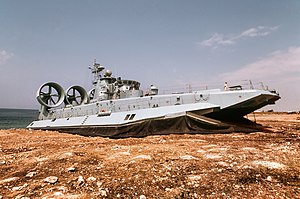 |
| Landed Zubr LCAC |
At full displacement the ship is capable of negotiating up to 5-degree gradients on non-equipped shores and 1.6m-high vertical walls. The Zubr remains seaworthy in conditions up to Sea State 4. The vessel has a cruising speed of 30-40 knots. Russian Video "amphibious hovercraft Zubr" below shows Zubr in action.
The report said China had already placed an order for four Zubr-class landing craft under a contract worth US$315 million. While two were constructed by the Ukraine-based Feodosiya Shipbuilding Company, the remaining two were licensed to be built in China.
Project Zubr* hovercraft are costly toys only superpowers can afford « Ilyashev & Partners Law Firm
Ukraine Shipyard reports the Zubr they are building for China is a significant upgrade from the Soviet Zubr design baseline. They are going to foreign sales to survive.
What we are building under a foreign contract is not a Zubr. Indeed, this is a genuinely Ukrainian project, codename 958. Although the project has a lot in common with the old Soviet Zubr, it is a brand new thing, completely rethought and improved. Design documentation is the property of the Ukrainian side. Soviet legacy in this case has served as a launching pad for Ukrainian know-how.
The enterprises of Ukrainian military industrial complex are facing hard times. The government is unable to provide proper financing to keep them running. Russia which has been a strategic partner for many years, is increasingly taking a hostile competitor position. European Union appreciates the quality of Ukrainian military produce but prefers to develop its counterpart projects. In a situation like this, each seeks its own ways to survive: one resort to maximum layoffs, other shifts to more in-demand products, and some are selling their intellectual property in order to stay afloat. To find out how the land lies with the industry in general and with More** Shipyard in Feodosiya, we contacted Roman Marchenko, Senior Partner at Ilyashev & Partners and the trustee in bankruptcy for More Shipyard.
Ukraine hands over first Zubr-class LCAC to China - IHS Jane's 360
The landing craft air cushion (LCAC) is the largest of its type in the world and was constructed at JSC Feodosia, according to a statement by Ukroboronprom. A second LCAC is under construction, the statement added, with a further two to be licence-built in China. The Zubr-class displaces 559 tonnes, has a length of 57.6 m and a beam of 25.6 m. It has a top speed of 63 kt and a range of 300 n miles at 55 kt.
Lecture on Basic Synthetic Aperture Radar Image Processing by Prof Josaphat - YouTube
Josaphat Tetuko Sri Sumantyo
 Prof. Josaphat 'Josh' Tetuko Sri Sumantyo, Ph.D., currently serves as Full Professor (permanent staff) at the Center for Environmental Remote Sensing, Chiba University , Japan and as professor / lecturer living in various universities [1] .
His inventions include:
Usually called Josh, he and his wife teach at Chiba University. They set up a foundation called Pandhito Flag Foundation (PPF) [10] to advancing research, education and fine arts in Indonesia. The foundation consists of the:
The results of the three research centers have been widely disseminated to the people of Indonesia, and published in various mass media at home and abroad. In particular the results of their work in the field of remote sensing [14] has been used by the Universities, Research Institutes, and Local Government to support the military in Indonesia and abroad for environment and disaster monitoring.
The 9th SAR Workshop | Josaphat Microwave Remote Sensing Laboratory (JMRSL)
▶ (1/5) Lecture on Basic Synthetic Aperture Radar Image Processing by Prof Josaphat - YouTube
▶ (2/5) Lecture on Basic Synthetic Aperture Radar Image Processing by Prof Josaphat - YouTube
▶ (3/5) Lecture on Basic Synthetic Aperture Radar Image Processing by Prof Josaphat - YouTube
▶ (4/5) Lecture on Basic Synthetic Aperture Radar Image Processing by Prof Josaphat - YouTube
▶ (5/5) Lecture on Basic Synthetic Aperture Radar Image Processing by Prof Josaphat - YouTube
Published on Oct 7, 2013
Lecture on Basic Synthetic Aperture Radar Image Processing by Prof Josaphat Tetuko Sri Sumantyo, Center for Environmental Remote Sensing, Chiba University, Japan (1/5).
JMRSL activities : http://www2.cr.chiba-u.jp/jmrsl/
https://www.facebook.com/pages/Josaph...
JMRSL activities : http://www2.cr.chiba-u.jp/jmrsl/
https://www.facebook.com/pages/Josaph...
Wednesday, January 1, 2014
Car Thieves hacking into cars - your car is not secure
Car makers and police seem to be stumped by this technology.
Car Thieves hacking into key fobs
LiveLeak.com - Car thieves rob vehicles using ‘mystery’ wireless devices: report (comments)

All over America, criminals are using improvised electronic devices to electronically unlock vehicles and steal whatever they find inside. These “mystery gadgets” reportedly recreate the same signals that the key fobs that so many of us carry around send out. As you will see below, footage is popping up nationwide of thieves using these “mystery gadgets” to remotely unlock car doors and disable alarm systems. Once a car has been unlocked, it takes these thieves just a few moments to take what they want before leaving without a trace. This is now happening all over the country, and authorities do not know any way to prevent it from happening. For now, the most common piece of advice that police are giving to people is to not leave any valuables inside your vehicle at all.
Thieves Use Mystery Device To Hack Car
Police are finally starting to catch up to crafty thieves who are using a cheap wireless fob to hack into cars. The device, which has been used in other break-ins around the world, had confounded authorities until now.
After being burglarized last year, Rick Henzel of Winnipeg, Man. installed security cameras and trained them on his driveway. The cameras caught a group of men as they walked up to his Lexus and unlocked the doors with an mysterious electronic instrument. They then helped themselves to the contents.
Michael Legary, a security expert with Seccuris, told CBC News that the thieves hacked into his car using a device that emits an electromagnetic pulse. The thieves used it to trick the car into thinking it was a legitimate key fob, enabling them to gain entrance and steal his valuables in mere minutes.
Subscribe to:
Posts (Atom)