The MQ-4C Triton Skysense Radar effort
Firstly, let's discuss the platform, mission, and system requirements and initial design as released.MQ-4C Triton Platform and Mission

Northrop Grumman MQ-4C Triton - Wikipedia, the free encyclopedia
Northrop Grumman’s MQ-4C Triton, the airborne element
of the U.S. Navy’s Broad Area Maritime Surveillance Unmanned Aircraft System (BAMS UAS). The Triton’s mission is to provide persistent maritime
intelligence, surveillance, and reconnaissance (ISR)
directly to the maritime commander. The MQ-4C Triton is a maritime derivative of the RQ-4B Global Hawk and provides
the U.S. Navy with
an autonomous air vehicle and mission control system.
•
Provides
persistent maritime
ISR at a mission radius of 2,000 nm; 24 hours/7 days per week with
80% Effective Time on Station
(ETOS)
•
Land-based air vehicle and sensor command
and control
•
Afloat Level II payload sensor data via line-of-sight
•
Dual
redundant flight controls and surfaces
•
51,000-hour airframe life
•
Due
regard radar for safe separation
•
Anti/de-ice,
bird strike, and lightning
protection
•
Communications bandwidth management
•
Commercial off-the-shelf open architecture mission control system
•
Net-ready interoperability
solution
General characteristics
- Crew: Aircraft is unmanned; 4 personnel required per ground station
- Dimensions
- Length: 47.6 ft in (14.5 m)
- Wingspan: 130.9 ft in (39.9 m)
- Height: 15.4 ft in (4.6 m)
- Powerplant: 1 × Rolls-Royce AE 3007 turbofan, 6,495-8,917 lbf (28.9-39.7 kN)
- Weight,
- Gross: 32,250 lb (14,630 kg)
- Max Internal Payload: 3,200 lb (1,452 kg)
- Max External Payload: 2,400 lb (1,089 kg)
- Maximum True Air speed: 331 kts (613 km/h)
- Endurance: 28 hours
- Service ceiling: 56,500 ft (17,220 m)
- Mission Radius: 2,000 nm
- Ferry Range: 8,200 nm (15,186 km)
Payload (360-degree Field of Regard)
•
Multi-Function
Active Sensor Active Electronically Steered Array (MFAS AESA) radar
–
2D AESA
–
Maritime and air-to-ground modes
–
Long-range detection and classification of targets
•
MTS-B multi-spectral targeting
system
–
Electro-optical/infrared
–
Auto-target tracking
–
High resolution at multiple
field-of-views
–
Full motion video
•
AN/ZLQ-1 Electronic Support Measures
–
All digital
–
Specific Emitter
Identification
•
Automatic Identification System
–
Provides
information received from
VHF
broadcasts on maritime vessel movements
Due Regard and Sense and Avoid Requirements
▶ Exelis SkySense 2020H airborne sense-and-avoid (ABSAA) System - YouTube
Airborne Sense and Avoid Radars for RPAs | Defense Update:
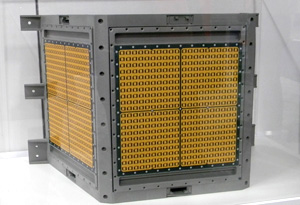
Teknologi Komputer dan Alutsista Militer: Airborne Sense and Avoid Radars for RPAs
At the AUVSI
exhibition last year ITT Exelis unveiled the SkySense 2020H airborne
sense-and-avoid (ABSAA) radar it said was under development for
the U.S. Navy’s MQ-4C Triton. The company is under contract from Northrop Grumman to
provide the air-to-air radar subsystem for the Triton. The
sense-and-avoid radar enables the aircraft to comply with the
International Civil Aviation Organization requirement that military and
other state aircraft operate with “due regard” for the safety of civil
aircraft when operating over international waters. The radar will
provide information to the RPA operator to maneuver the aircraft away
from possible collisions; maintaining ‘air traffic separation’. In the
future, an autonomous aircraft will perform its own maneuvers based on
the ABSAA radar data (Collision avoidance mode).
According
to AIN’s Bill Carey, the radar:
ITT Exelis Shows Sense-and-Avoid Radar for Navy’s MQ-4C | Aviation International News- will be positioned behind the nose cone of the aircraft,
- the ABSAA radar is a three-panel, thin-tile array
- operating in the Ku-band.
- The range will be 8 to 10 nm,
- with a wide field of view
- 110 degrees on either side and
- 30 degrees up and down.
- The system is
- self-contained, with no supporting racks of processing electronics,
- weighs 50 pounds.
April 9/14: Sense-and-Avoid.
The US Navy still wants to place this technology on the MQ-4C, not least because it will be required for low-altitude flying in many areas of interest. The problem is that miniaturizing the Exelis AESA radar turned out to be much harder than they thought, to the point where they had to pause and look at other options (q.v. Aug 13/13).Above 18,000′, standard ADS-B (Automatic Dependent Surveillance-Broadcast) and TCAS (Traffic Collision Avoidance System) “due regard” systems can keep the UAV from getting too close to civilian aircraft, and to many military airplanes as well. Below that altitude, ground and ship-based radars can be used, and something might be doable using aerial radars like AWACS plus datalinks. On the other hand, the whole point of the MQ-4C is to survey areas where those assets aren’t already on patrol.
This is a serious issue for UAVs generally, so it may be worth biting the bullet and investing the funds required to solve the problem. It may even be a hard and significant enough problem to justify DARPA’s involvement. Sources: Navy Expanding Search for 'Sense and Avoid' Technologies for Triton | USNI News
Mike Mackey, Northrop’s Triton program manager, said that the fundamental problem was that it proved to be far more difficult than anticipated to package an active electronically scanned array radar into such small space. It was simply too difficult to meet the weight, cooling and power requirements. “Miniaturizing that—if you will—that kind of a radar suite turned out to be more challenging than we initially thought,” Burke said.US Navy Triton Programme Advances without “Sense-and-Avoid” System | UAS VISION
While Exelis is still on contract to build the sense-and-avoid radar as a subcontractor, Mackey said that Northrop has placed a stop work order on the system. Burke said that the program has not made a decision on whether to continue to develop the Exelis-made radar or go in a different direction.
Troublesome Radar Delays Triton UAV Development | Israel
More drones for Navy | UTSanDiego.com
Aug 13/13: Sense-and-Avoid.
BAMS Program manager Navy Capt. Jim Hoke says that ITT Exelis’ radar-based Airborne Sense And Avoid system (q.v. Aug 10/12) is “behind schedule,” so the Navy has “made a decision to pause on the capability right now” and has stopped work. Hoke says that he understands how important this capability is for operations in crowded airspace and allied countries (vid. May 29/13, May 14/13), especially given the MQ-4C’s operational need to descend to lower altitudes at times for a closer look, but “all options are on the table.” If the system really is seen as critical, that could mean a re-compete of the sub-program, or the Navy could decide to join the USAF’s ABSAA effort (q.v. July 30/12).Re-competes can be problematic, but this may be a case where the circumstances are attractive. The natural scalability of AESA radars means that any successful implementation could be applied to other large UAVs, from NATO’s planned RQ-4 Block 40 AGS Global Hawk variant, to smaller MALE UAVs like the MQ-9 Reaper or MQ-1C Gray Eagle. That’s a significant and growing opportunity for the winning contractor, with follow-on “proven leader” opportunities around civil UAV use. This dynamic could attract firms willing to invest up front with low bids or substantial resources, and the base ABSAA field is a mature one thanks to civil aircraft. Breaking Defense.
Sense-And-Avoid radar on hold
May 29/13: Sense-and-Avoid.
Answers from Northrop Grumman clarify the MQ-4C’s sense-and-avoid systems:“Triton’s due regard radar is meant to provide safe separation of aircraft while the system is in flight at lower altitudes. The U.S. Navy’s mission requires that Triton be able to descend to lower altitudes to make closer identification of surface vessels. The radar is still in development and would be flight tested on Triton at a later date. This is a Navy requirement to ensure that the Triton UAs can safely operate over international waters.”With respect to ICAO certification issues, Northrop Grumman would only say Global Hawk is the first unmanned aircraft system to achieve a military airworthiness certification. That can only be used to fly a pre-approved, monitored flight plan in American civil airspace, and then only if a specific supplemental FAA certificate of authorization (COA) is granted in advance. Whether this level of certification will work at NAS Sigonella, Italy is a question that the US Navy will need to answer. “Saigon” has already been a base of operations for RQ-4B Block 20 Global Hawks, which lack any form of collision avoidance system. The question is how restricted future MQ-4C flight options would be, absent further certifications.
Feb 18/11: Sense & Avoid.
Northrop Grumman Aerospace Sector’s Battle Management & Engagement Systems Division in Bethpage, NY receives a $25.6 million cost-plus-fixed-fee delivery order to develop an “airborne sense and avoid capability for the Broad Area Maritime Surveillance (BAMS) unmanned aircraft system in support of the Navy and Air Force.” The goal is a TRL 7 system, i.e. a prototype tested in operationally-relevant conditions.The wording is interesting, as it implies that USAF RQ-4A/B Global Hawks will also be fitted with this capability. As they should be. Sense and avoid technologies are used in commercial aircraft, in order to prevent mid-air collisions. While flying at 60,000 feet will go a long way toward zero collisions, the UAVs do not begin at that altitude, and BAMS in particular will not spend all of its mission time at that level. Throw in funded experiments like aerial refueling between 2 Global Hawk UAVs, and expectations that the stratosphere is likely to be more crowded in future, and the necessity of sense & avoid technologies becomes clearer. To this point, however, the US Navy and USAF have pursued different technology approaches: an ITT-supplied air-to-air radar and ADS-B cooperative surveillance for the Navy, and a multi-sensor “multi-intruder autonomous avoidance (MIAA)” USAF project that uses 3 electro-optical cameras, a low-power radar, and the civil TCAS traffic collision avoidance system.
Work to reconcile those approaches into a common prototype will be performed in Bethpage, NY (50%) and San Diego, CA (50%), and is expected to be complete in November 2012. $7,368,022 will expire at the end of the current fiscal year, on Sept 30/11 (N00019-10-G-0004). See also: Aviation Week.


